OpenAPI 中的附加响应
警告
这是一个相对高级的话题。
如果你刚开始使用 FastAPI,可能暂时用不到。
你可以声明附加响应,包括额外的状态码、媒体类型、描述等。
这些附加响应会被包含在 OpenAPI 模式中,因此它们也会出现在 API 文档中。
但是对于这些附加响应,你必须确保直接返回一个 Response(例如 JSONResponse),并携带你的状态码和内容。
带有 model 的附加响应
你可以向你的路径操作装饰器传入参数 responses。
它接收一个 dict:键是每个响应的状态码(例如 200),值是包含该响应信息的另一个 dict。
这些响应的每个 dict 都可以有一个键 model,包含一个 Pydantic 模型,就像 response_model 一样。
FastAPI 会获取该模型,生成它的 JSON Schema,并将其放在 OpenAPI 中的正确位置。
例如,要声明另一个状态码为 404 且具有 Pydantic 模型 Message 的响应,你可以这样写:
from fastapi import FastAPI
from fastapi.responses import JSONResponse
from pydantic import BaseModel


class Item(BaseModel):
    id: str
    value: str


class Message(BaseModel):
    message: str


app = FastAPI()


@app.get("/items/{item_id}", response_model=Item, responses={404: {"model": Message}})
async def read_item(item_id: str):
    if item_id == "foo":
        return {"id": "foo", "value": "there goes my hero"}
    return JSONResponse(status_code=404, content={"message": "Item not found"})
注意
记住你需要直接返回 JSONResponse。
信息
model 键不是 OpenAPI 的一部分。
FastAPI 会从这里获取 Pydantic 模型,生成 JSON Schema,并把它放到正确的位置。
正确的位置是:
- 在键
content中,它的值是另一个 JSON 对象(dict),该对象包含:- 一个媒体类型作为键,例如
application/json,它的值是另一个 JSON 对象,该对象包含:- 一个键
schema,它的值是来自该模型的 JSON Schema,这里就是正确的位置。- FastAPI 会在这里添加一个引用,指向你 OpenAPI 中另一个位置的全局 JSON Schemas,而不是直接内联。这样,其他应用和客户端可以直接使用这些 JSON Schemas,提供更好的代码生成工具等。
- 一个键
- 一个媒体类型作为键,例如
为该路径操作在 OpenAPI 中生成的响应将是:
{
    "responses": {
        "404": {
            "description": "Additional Response",
            "content": {
                "application/json": {
                    "schema": {
                        "$ref": "#/components/schemas/Message"
                    }
                }
            }
        },
        "200": {
            "description": "Successful Response",
            "content": {
                "application/json": {
                    "schema": {
                        "$ref": "#/components/schemas/Item"
                    }
                }
            }
        },
        "422": {
            "description": "Validation Error",
            "content": {
                "application/json": {
                    "schema": {
                        "$ref": "#/components/schemas/HTTPValidationError"
                    }
                }
            }
        }
    }
}
这些模式在 OpenAPI 模式中被引用到另一个位置:
{
    "components": {
        "schemas": {
            "Message": {
                "title": "Message",
                "required": [
                    "message"
                ],
                "type": "object",
                "properties": {
                    "message": {
                        "title": "Message",
                        "type": "string"
                    }
                }
            },
            "Item": {
                "title": "Item",
                "required": [
                    "id",
                    "value"
                ],
                "type": "object",
                "properties": {
                    "id": {
                        "title": "Id",
                        "type": "string"
                    },
                    "value": {
                        "title": "Value",
                        "type": "string"
                    }
                }
            },
            "ValidationError": {
                "title": "ValidationError",
                "required": [
                    "loc",
                    "msg",
                    "type"
                ],
                "type": "object",
                "properties": {
                    "loc": {
                        "title": "Location",
                        "type": "array",
                        "items": {
                            "type": "string"
                        }
                    },
                    "msg": {
                        "title": "Message",
                        "type": "string"
                    },
                    "type": {
                        "title": "Error Type",
                        "type": "string"
                    }
                }
            },
            "HTTPValidationError": {
                "title": "HTTPValidationError",
                "type": "object",
                "properties": {
                    "detail": {
                        "title": "Detail",
                        "type": "array",
                        "items": {
                            "$ref": "#/components/schemas/ValidationError"
                        }
                    }
                }
            }
        }
    }
}
主响应的其他媒体类型
你可以使用同一个 responses 参数为同一个主响应添加不同的媒体类型。
例如,你可以添加一个额外的媒体类型 image/png,声明你的路径操作可以返回 JSON 对象(媒体类型为 application/json)或 PNG 图片:
from fastapi import FastAPI
from fastapi.responses import FileResponse
from pydantic import BaseModel


class Item(BaseModel):
    id: str
    value: str


app = FastAPI()


@app.get(
    "/items/{item_id}",
    response_model=Item,
    responses={
        200: {
            "content": {"image/png": {}},
            "description": "Return the JSON item or an image.",
        }
    },
)
async def read_item(item_id: str, img: bool | None = None):
    if img:
        return FileResponse("image.png", media_type="image/png")
    else:
        return {"id": "foo", "value": "there goes my hero"}
注意
请注意,你必须直接使用 FileResponse 返回图片。
信息
除非你在 responses 参数中明确指定不同的媒体类型,否则 FastAPI 会假设响应与主响应类具有相同的媒体类型(默认是 application/json)。
但是如果你指定了一个媒体类型为 None 的自定义响应类,FastAPI 会对任何具有关联模型的附加响应使用 application/json。
组合信息
你也可以把来自多个位置的响应信息组合在一起,包括 response_model、status_code 和 responses 参数。
你可以声明一个 response_model,使用默认状态码 200(或根据需要使用自定义状态码),然后在 responses 中直接在 OpenAPI 模式里为同一个响应声明附加信息。
FastAPI 会保留来自 responses 的附加信息,并把它与你的模型生成的 JSON Schema 合并。
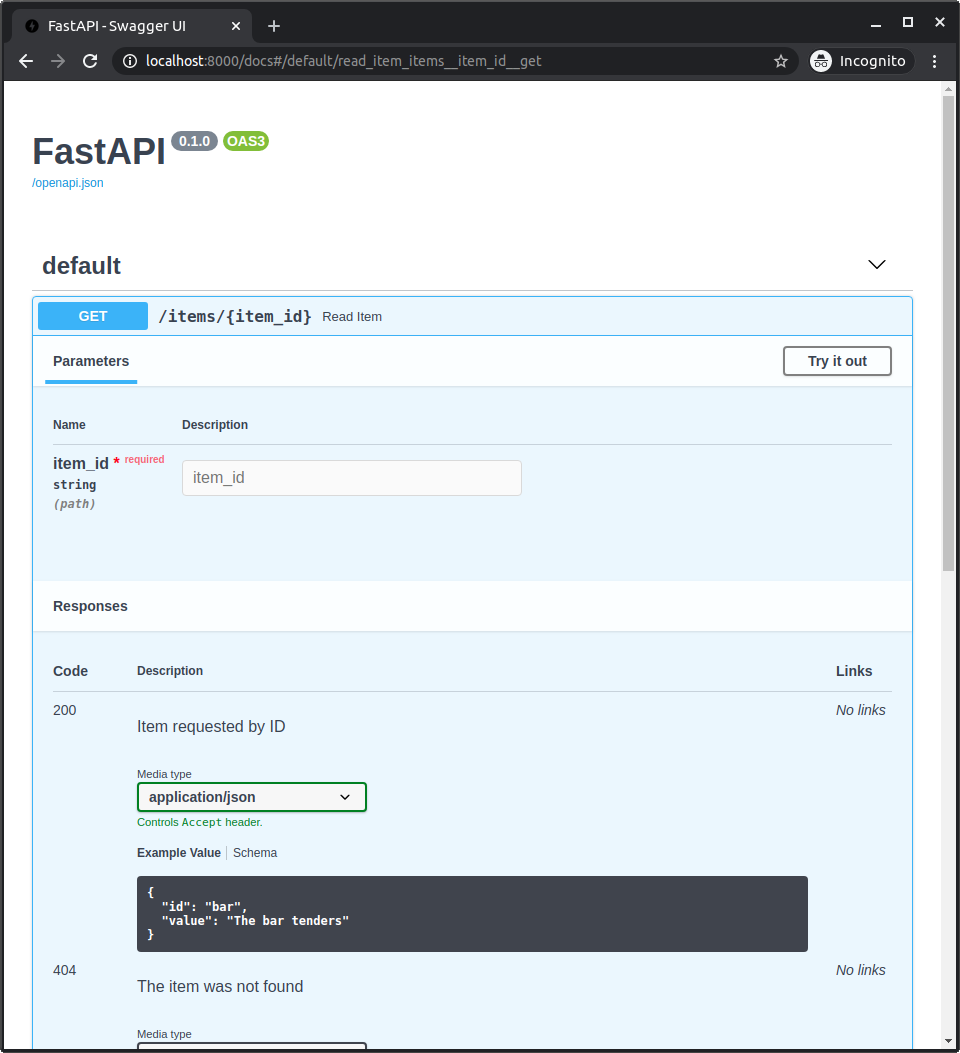
例如,你可以声明一个状态码为 404 的响应,它使用一个 Pydantic 模型并带有自定义的 description。
以及一个状态码为 200 的响应,它使用你的 response_model,但包含自定义的 example:
from fastapi import FastAPI
from fastapi.responses import JSONResponse
from pydantic import BaseModel


class Item(BaseModel):
    id: str
    value: str


class Message(BaseModel):
    message: str


app = FastAPI()


@app.get(
    "/items/{item_id}",
    response_model=Item,
    responses={
        404: {"model": Message, "description": "The item was not found"},
        200: {
            "description": "Item requested by ID",
            "content": {
                "application/json": {
                    "example": {"id": "bar", "value": "The bar tenders"}
                }
            },
        },
    },
)
async def read_item(item_id: str):
    if item_id == "foo":
        return {"id": "foo", "value": "there goes my hero"}
    else:
        return JSONResponse(status_code=404, content={"message": "Item not found"})
所有这些都会被合并并包含到你的 OpenAPI 中,并显示在 API 文档里:
组合预定义响应和自定义响应
你可能希望有一些适用于许多路径操作的预定义响应,但同时又想把它们与每个路径操作所需的自定义响应组合在一起。
在这些情况下,你可以使用 Python 的“解包”dict 的技巧 **dict_to_unpack:
old_dict = {
    "old key": "old value",
    "second old key": "second old value",
}
new_dict = {**old_dict, "new key": "new value"}
这里,new_dict 将包含来自 old_dict 的所有键值对,再加上新的键值对:
{
    "old key": "old value",
    "second old key": "second old value",
    "new key": "new value",
}
你可以使用该技巧在路径操作中重用一些预定义响应,并把它们与额外的自定义响应组合在一起。
例如:
from fastapi import FastAPI
from fastapi.responses import FileResponse
from pydantic import BaseModel


class Item(BaseModel):
    id: str
    value: str


responses = {
    404: {"description": "Item not found"},
    302: {"description": "The item was moved"},
    403: {"description": "Not enough privileges"},
}


app = FastAPI()


@app.get(
    "/items/{item_id}",
    response_model=Item,
    responses={**responses, 200: {"content": {"image/png": {}}}},
)
async def read_item(item_id: str, img: bool | None = None):
    if img:
        return FileResponse("image.png", media_type="image/png")
    else:
        return {"id": "foo", "value": "there goes my hero"}
关于 OpenAPI 响应的更多信息
要查看响应中究竟可以包含什么,你可以查看 OpenAPI 规范中的以下部分:
- OpenAPI Responses 对象,它包含
Response Object。 - OpenAPI Response 对象,你可以把这里的任何内容直接包含到
responses参数中的每个响应里。包括description、headers、content(在这里声明不同的媒体类型和 JSON Schemas),以及links。