OAuth2 範圍(scopes)
你可以直接在 FastAPI 中使用 OAuth2 的 scopes,已整合可無縫運作。
這能讓你在 OpenAPI 應用(以及 API 文件)中,依照 OAuth2 標準,實作更細粒度的權限系統。
帶有 scopes 的 OAuth2 是許多大型身分驗證提供者(如 Facebook、Google、GitHub、Microsoft、X(Twitter)等)所使用的機制。他們用它來為使用者與應用程式提供特定權限。
每次你「使用」Facebook、Google、GitHub、Microsoft、X(Twitter)「登入」時,那個應用就是在使用帶有 scopes 的 OAuth2。
在本節中,你將看到如何在你的 FastAPI 應用中,用同樣的帶有 scopes 的 OAuth2 管理驗證與授權。
Warning
這一節算是進階內容。如果你剛開始,可以先跳過。
你不一定需要 OAuth2 scopes,你可以用任何你想要的方式處理驗證與授權。
但帶有 scopes 的 OAuth2 可以很漂亮地整合進你的 API(透過 OpenAPI)與 API 文件。
無論如何,你仍然會在程式碼中,依你的需求,強制檢查那些 scopes,或其他任何安全性/授權需求。
在許多情況下,帶有 scopes 的 OAuth2 可能有點大材小用。
但如果你確定需要,或是好奇,請繼續閱讀。
OAuth2 scopes 與 OpenAPI
OAuth2 規格將「scopes」定義為以空白分隔的一串字串列表。
每個字串的內容可以有任意格式,但不應包含空白。
這些 scopes 代表「權限」。
在 OpenAPI(例如 API 文件)中,你可以定義「security schemes」。
當某個 security scheme 使用 OAuth2 時,你也可以宣告並使用 scopes。
每個「scope」就是一個(不含空白的)字串。
它們通常用來宣告特定的安全性權限,例如:
users:read或users:write是常見的例子。instagram_basic是 Facebook / Instagram 使用的。https://www.googleapis.com/auth/drive是 Google 使用的。
Info
在 OAuth2 中,「scope」只是宣告所需特定權限的一個字串。
是否包含像 : 這樣的字元,或是否是一個 URL,都沒差。
那些細節取決於實作。
對 OAuth2 而言,它們就是字串。
全局概觀
先快速看看相對於主教學「使用密碼(與雜湊)、Bearer 與 JWT token 的 OAuth2」的差異(OAuth2 with Password (and hashing), Bearer with JWT tokens)。現在加入了 OAuth2 scopes:
from datetime import datetime, timedelta, timezone
from typing import Annotated

import jwt
from fastapi import Depends, FastAPI, HTTPException, Security, status
from fastapi.security import (
    OAuth2PasswordBearer,
    OAuth2PasswordRequestForm,
    SecurityScopes,
)
from jwt.exceptions import InvalidTokenError
from pwdlib import PasswordHash
from pydantic import BaseModel, ValidationError

# to get a string like this run:
# openssl rand -hex 32
SECRET_KEY = "09d25e094faa6ca2556c818166b7a9563b93f7099f6f0f4caa6cf63b88e8d3e7"
ALGORITHM = "HS256"
ACCESS_TOKEN_EXPIRE_MINUTES = 30


fake_users_db = {
    "johndoe": {
        "username": "johndoe",
        "full_name": "John Doe",
        "email": "johndoe@example.com",
        "hashed_password": "$argon2id$v=19$m=65536,t=3,p=4$wagCPXjifgvUFBzq4hqe3w$CYaIb8sB+wtD+Vu/P4uod1+Qof8h+1g7bbDlBID48Rc",
        "disabled": False,
    },
    "alice": {
        "username": "alice",
        "full_name": "Alice Chains",
        "email": "alicechains@example.com",
        "hashed_password": "$argon2id$v=19$m=65536,t=3,p=4$g2/AV1zwopqUntPKJavBFw$BwpRGDCyUHLvHICnwijyX8ROGoiUPwNKZ7915MeYfCE",
        "disabled": True,
    },
}


class Token(BaseModel):
    access_token: str
    token_type: str


class TokenData(BaseModel):
    username: str | None = None
    scopes: list[str] = []


class User(BaseModel):
    username: str
    email: str | None = None
    full_name: str | None = None
    disabled: bool | None = None


class UserInDB(User):
    hashed_password: str


password_hash = PasswordHash.recommended()

DUMMY_HASH = password_hash.hash("dummypassword")

oauth2_scheme = OAuth2PasswordBearer(
    tokenUrl="token",
    scopes={"me": "Read information about the current user.", "items": "Read items."},
)

app = FastAPI()


def verify_password(plain_password, hashed_password):
    return password_hash.verify(plain_password, hashed_password)


def get_password_hash(password):
    return password_hash.hash(password)


def get_user(db, username: str):
    if username in db:
        user_dict = db[username]
        return UserInDB(**user_dict)


def authenticate_user(fake_db, username: str, password: str):
    user = get_user(fake_db, username)
    if not user:
        verify_password(password, DUMMY_HASH)
        return False
    if not verify_password(password, user.hashed_password):
        return False
    return user


def create_access_token(data: dict, expires_delta: timedelta | None = None):
    to_encode = data.copy()
    if expires_delta:
        expire = datetime.now(timezone.utc) + expires_delta
    else:
        expire = datetime.now(timezone.utc) + timedelta(minutes=15)
    to_encode.update({"exp": expire})
    encoded_jwt = jwt.encode(to_encode, SECRET_KEY, algorithm=ALGORITHM)
    return encoded_jwt


async def get_current_user(
    security_scopes: SecurityScopes, token: Annotated[str, Depends(oauth2_scheme)]
):
    if security_scopes.scopes:
        authenticate_value = f'Bearer scope="{security_scopes.scope_str}"'
    else:
        authenticate_value = "Bearer"
    credentials_exception = HTTPException(
        status_code=status.HTTP_401_UNAUTHORIZED,
        detail="Could not validate credentials",
        headers={"WWW-Authenticate": authenticate_value},
    )
    try:
        payload = jwt.decode(token, SECRET_KEY, algorithms=[ALGORITHM])
        username = payload.get("sub")
        if username is None:
            raise credentials_exception
        scope: str = payload.get("scope", "")
        token_scopes = scope.split(" ")
        token_data = TokenData(scopes=token_scopes, username=username)
    except (InvalidTokenError, ValidationError):
        raise credentials_exception
    user = get_user(fake_users_db, username=token_data.username)
    if user is None:
        raise credentials_exception
    for scope in security_scopes.scopes:
        if scope not in token_data.scopes:
            raise HTTPException(
                status_code=status.HTTP_401_UNAUTHORIZED,
                detail="Not enough permissions",
                headers={"WWW-Authenticate": authenticate_value},
            )
    return user


async def get_current_active_user(
    current_user: Annotated[User, Security(get_current_user, scopes=["me"])],
):
    if current_user.disabled:
        raise HTTPException(status_code=400, detail="Inactive user")
    return current_user


@app.post("/token")
async def login_for_access_token(
    form_data: Annotated[OAuth2PasswordRequestForm, Depends()],
) -> Token:
    user = authenticate_user(fake_users_db, form_data.username, form_data.password)
    if not user:
        raise HTTPException(status_code=400, detail="Incorrect username or password")
    access_token_expires = timedelta(minutes=ACCESS_TOKEN_EXPIRE_MINUTES)
    access_token = create_access_token(
        data={"sub": user.username, "scope": " ".join(form_data.scopes)},
        expires_delta=access_token_expires,
    )
    return Token(access_token=access_token, token_type="bearer")


@app.get("/users/me/")
async def read_users_me(
    current_user: Annotated[User, Depends(get_current_active_user)],
) -> User:
    return current_user


@app.get("/users/me/items/")
async def read_own_items(
    current_user: Annotated[User, Security(get_current_active_user, scopes=["items"])],
):
    return [{"item_id": "Foo", "owner": current_user.username}]


@app.get("/status/")
async def read_system_status(current_user: Annotated[User, Depends(get_current_user)]):
    return {"status": "ok"}
🤓 Other versions and variants
Tip
Prefer to use the Annotated version if possible.
from datetime import datetime, timedelta, timezone

import jwt
from fastapi import Depends, FastAPI, HTTPException, Security, status
from fastapi.security import (
    OAuth2PasswordBearer,
    OAuth2PasswordRequestForm,
    SecurityScopes,
)
from jwt.exceptions import InvalidTokenError
from pwdlib import PasswordHash
from pydantic import BaseModel, ValidationError

# to get a string like this run:
# openssl rand -hex 32
SECRET_KEY = "09d25e094faa6ca2556c818166b7a9563b93f7099f6f0f4caa6cf63b88e8d3e7"
ALGORITHM = "HS256"
ACCESS_TOKEN_EXPIRE_MINUTES = 30


fake_users_db = {
    "johndoe": {
        "username": "johndoe",
        "full_name": "John Doe",
        "email": "johndoe@example.com",
        "hashed_password": "$argon2id$v=19$m=65536,t=3,p=4$wagCPXjifgvUFBzq4hqe3w$CYaIb8sB+wtD+Vu/P4uod1+Qof8h+1g7bbDlBID48Rc",
        "disabled": False,
    },
    "alice": {
        "username": "alice",
        "full_name": "Alice Chains",
        "email": "alicechains@example.com",
        "hashed_password": "$argon2id$v=19$m=65536,t=3,p=4$g2/AV1zwopqUntPKJavBFw$BwpRGDCyUHLvHICnwijyX8ROGoiUPwNKZ7915MeYfCE",
        "disabled": True,
    },
}


class Token(BaseModel):
    access_token: str
    token_type: str


class TokenData(BaseModel):
    username: str | None = None
    scopes: list[str] = []


class User(BaseModel):
    username: str
    email: str | None = None
    full_name: str | None = None
    disabled: bool | None = None


class UserInDB(User):
    hashed_password: str


password_hash = PasswordHash.recommended()

DUMMY_HASH = password_hash.hash("dummypassword")

oauth2_scheme = OAuth2PasswordBearer(
    tokenUrl="token",
    scopes={"me": "Read information about the current user.", "items": "Read items."},
)

app = FastAPI()


def verify_password(plain_password, hashed_password):
    return password_hash.verify(plain_password, hashed_password)


def get_password_hash(password):
    return password_hash.hash(password)


def get_user(db, username: str):
    if username in db:
        user_dict = db[username]
        return UserInDB(**user_dict)


def authenticate_user(fake_db, username: str, password: str):
    user = get_user(fake_db, username)
    if not user:
        verify_password(password, DUMMY_HASH)
        return False
    if not verify_password(password, user.hashed_password):
        return False
    return user


def create_access_token(data: dict, expires_delta: timedelta | None = None):
    to_encode = data.copy()
    if expires_delta:
        expire = datetime.now(timezone.utc) + expires_delta
    else:
        expire = datetime.now(timezone.utc) + timedelta(minutes=15)
    to_encode.update({"exp": expire})
    encoded_jwt = jwt.encode(to_encode, SECRET_KEY, algorithm=ALGORITHM)
    return encoded_jwt


async def get_current_user(
    security_scopes: SecurityScopes, token: str = Depends(oauth2_scheme)
):
    if security_scopes.scopes:
        authenticate_value = f'Bearer scope="{security_scopes.scope_str}"'
    else:
        authenticate_value = "Bearer"
    credentials_exception = HTTPException(
        status_code=status.HTTP_401_UNAUTHORIZED,
        detail="Could not validate credentials",
        headers={"WWW-Authenticate": authenticate_value},
    )
    try:
        payload = jwt.decode(token, SECRET_KEY, algorithms=[ALGORITHM])
        username: str = payload.get("sub")
        if username is None:
            raise credentials_exception
        scope: str = payload.get("scope", "")
        token_scopes = scope.split(" ")
        token_data = TokenData(scopes=token_scopes, username=username)
    except (InvalidTokenError, ValidationError):
        raise credentials_exception
    user = get_user(fake_users_db, username=token_data.username)
    if user is None:
        raise credentials_exception
    for scope in security_scopes.scopes:
        if scope not in token_data.scopes:
            raise HTTPException(
                status_code=status.HTTP_401_UNAUTHORIZED,
                detail="Not enough permissions",
                headers={"WWW-Authenticate": authenticate_value},
            )
    return user


async def get_current_active_user(
    current_user: User = Security(get_current_user, scopes=["me"]),
):
    if current_user.disabled:
        raise HTTPException(status_code=400, detail="Inactive user")
    return current_user


@app.post("/token")
async def login_for_access_token(
    form_data: OAuth2PasswordRequestForm = Depends(),
) -> Token:
    user = authenticate_user(fake_users_db, form_data.username, form_data.password)
    if not user:
        raise HTTPException(status_code=400, detail="Incorrect username or password")
    access_token_expires = timedelta(minutes=ACCESS_TOKEN_EXPIRE_MINUTES)
    access_token = create_access_token(
        data={"sub": user.username, "scope": " ".join(form_data.scopes)},
        expires_delta=access_token_expires,
    )
    return Token(access_token=access_token, token_type="bearer")


@app.get("/users/me/")
async def read_users_me(current_user: User = Depends(get_current_active_user)) -> User:
    return current_user


@app.get("/users/me/items/")
async def read_own_items(
    current_user: User = Security(get_current_active_user, scopes=["items"]),
):
    return [{"item_id": "Foo", "owner": current_user.username}]


@app.get("/status/")
async def read_system_status(current_user: User = Depends(get_current_user)):
    return {"status": "ok"}
接著我們一步一步檢視這些變更。
OAuth2 安全性方案
第一個變更是:我們現在宣告了帶有兩個可用 scope 的 OAuth2 安全性方案,me 與 items。
參數 scopes 接收一個 dict,以各 scope 為鍵、其描述為值:
from datetime import datetime, timedelta, timezone
from typing import Annotated

import jwt
from fastapi import Depends, FastAPI, HTTPException, Security, status
from fastapi.security import (
    OAuth2PasswordBearer,
    OAuth2PasswordRequestForm,
    SecurityScopes,
)
from jwt.exceptions import InvalidTokenError
from pwdlib import PasswordHash
from pydantic import BaseModel, ValidationError

# to get a string like this run:
# openssl rand -hex 32
SECRET_KEY = "09d25e094faa6ca2556c818166b7a9563b93f7099f6f0f4caa6cf63b88e8d3e7"
ALGORITHM = "HS256"
ACCESS_TOKEN_EXPIRE_MINUTES = 30


fake_users_db = {
    "johndoe": {
        "username": "johndoe",
        "full_name": "John Doe",
        "email": "johndoe@example.com",
        "hashed_password": "$argon2id$v=19$m=65536,t=3,p=4$wagCPXjifgvUFBzq4hqe3w$CYaIb8sB+wtD+Vu/P4uod1+Qof8h+1g7bbDlBID48Rc",
        "disabled": False,
    },
    "alice": {
        "username": "alice",
        "full_name": "Alice Chains",
        "email": "alicechains@example.com",
        "hashed_password": "$argon2id$v=19$m=65536,t=3,p=4$g2/AV1zwopqUntPKJavBFw$BwpRGDCyUHLvHICnwijyX8ROGoiUPwNKZ7915MeYfCE",
        "disabled": True,
    },
}


class Token(BaseModel):
    access_token: str
    token_type: str


class TokenData(BaseModel):
    username: str | None = None
    scopes: list[str] = []


class User(BaseModel):
    username: str
    email: str | None = None
    full_name: str | None = None
    disabled: bool | None = None


class UserInDB(User):
    hashed_password: str


password_hash = PasswordHash.recommended()

DUMMY_HASH = password_hash.hash("dummypassword")

oauth2_scheme = OAuth2PasswordBearer(
    tokenUrl="token",
    scopes={"me": "Read information about the current user.", "items": "Read items."},
)

app = FastAPI()


def verify_password(plain_password, hashed_password):
    return password_hash.verify(plain_password, hashed_password)


def get_password_hash(password):
    return password_hash.hash(password)


def get_user(db, username: str):
    if username in db:
        user_dict = db[username]
        return UserInDB(**user_dict)


def authenticate_user(fake_db, username: str, password: str):
    user = get_user(fake_db, username)
    if not user:
        verify_password(password, DUMMY_HASH)
        return False
    if not verify_password(password, user.hashed_password):
        return False
    return user


def create_access_token(data: dict, expires_delta: timedelta | None = None):
    to_encode = data.copy()
    if expires_delta:
        expire = datetime.now(timezone.utc) + expires_delta
    else:
        expire = datetime.now(timezone.utc) + timedelta(minutes=15)
    to_encode.update({"exp": expire})
    encoded_jwt = jwt.encode(to_encode, SECRET_KEY, algorithm=ALGORITHM)
    return encoded_jwt


async def get_current_user(
    security_scopes: SecurityScopes, token: Annotated[str, Depends(oauth2_scheme)]
):
    if security_scopes.scopes:
        authenticate_value = f'Bearer scope="{security_scopes.scope_str}"'
    else:
        authenticate_value = "Bearer"
    credentials_exception = HTTPException(
        status_code=status.HTTP_401_UNAUTHORIZED,
        detail="Could not validate credentials",
        headers={"WWW-Authenticate": authenticate_value},
    )
    try:
        payload = jwt.decode(token, SECRET_KEY, algorithms=[ALGORITHM])
        username = payload.get("sub")
        if username is None:
            raise credentials_exception
        scope: str = payload.get("scope", "")
        token_scopes = scope.split(" ")
        token_data = TokenData(scopes=token_scopes, username=username)
    except (InvalidTokenError, ValidationError):
        raise credentials_exception
    user = get_user(fake_users_db, username=token_data.username)
    if user is None:
        raise credentials_exception
    for scope in security_scopes.scopes:
        if scope not in token_data.scopes:
            raise HTTPException(
                status_code=status.HTTP_401_UNAUTHORIZED,
                detail="Not enough permissions",
                headers={"WWW-Authenticate": authenticate_value},
            )
    return user


async def get_current_active_user(
    current_user: Annotated[User, Security(get_current_user, scopes=["me"])],
):
    if current_user.disabled:
        raise HTTPException(status_code=400, detail="Inactive user")
    return current_user


@app.post("/token")
async def login_for_access_token(
    form_data: Annotated[OAuth2PasswordRequestForm, Depends()],
) -> Token:
    user = authenticate_user(fake_users_db, form_data.username, form_data.password)
    if not user:
        raise HTTPException(status_code=400, detail="Incorrect username or password")
    access_token_expires = timedelta(minutes=ACCESS_TOKEN_EXPIRE_MINUTES)
    access_token = create_access_token(
        data={"sub": user.username, "scope": " ".join(form_data.scopes)},
        expires_delta=access_token_expires,
    )
    return Token(access_token=access_token, token_type="bearer")


@app.get("/users/me/")
async def read_users_me(
    current_user: Annotated[User, Depends(get_current_active_user)],
) -> User:
    return current_user


@app.get("/users/me/items/")
async def read_own_items(
    current_user: Annotated[User, Security(get_current_active_user, scopes=["items"])],
):
    return [{"item_id": "Foo", "owner": current_user.username}]


@app.get("/status/")
async def read_system_status(current_user: Annotated[User, Depends(get_current_user)]):
    return {"status": "ok"}
🤓 Other versions and variants
Tip
Prefer to use the Annotated version if possible.
from datetime import datetime, timedelta, timezone

import jwt
from fastapi import Depends, FastAPI, HTTPException, Security, status
from fastapi.security import (
    OAuth2PasswordBearer,
    OAuth2PasswordRequestForm,
    SecurityScopes,
)
from jwt.exceptions import InvalidTokenError
from pwdlib import PasswordHash
from pydantic import BaseModel, ValidationError

# to get a string like this run:
# openssl rand -hex 32
SECRET_KEY = "09d25e094faa6ca2556c818166b7a9563b93f7099f6f0f4caa6cf63b88e8d3e7"
ALGORITHM = "HS256"
ACCESS_TOKEN_EXPIRE_MINUTES = 30


fake_users_db = {
    "johndoe": {
        "username": "johndoe",
        "full_name": "John Doe",
        "email": "johndoe@example.com",
        "hashed_password": "$argon2id$v=19$m=65536,t=3,p=4$wagCPXjifgvUFBzq4hqe3w$CYaIb8sB+wtD+Vu/P4uod1+Qof8h+1g7bbDlBID48Rc",
        "disabled": False,
    },
    "alice": {
        "username": "alice",
        "full_name": "Alice Chains",
        "email": "alicechains@example.com",
        "hashed_password": "$argon2id$v=19$m=65536,t=3,p=4$g2/AV1zwopqUntPKJavBFw$BwpRGDCyUHLvHICnwijyX8ROGoiUPwNKZ7915MeYfCE",
        "disabled": True,
    },
}


class Token(BaseModel):
    access_token: str
    token_type: str


class TokenData(BaseModel):
    username: str | None = None
    scopes: list[str] = []


class User(BaseModel):
    username: str
    email: str | None = None
    full_name: str | None = None
    disabled: bool | None = None


class UserInDB(User):
    hashed_password: str


password_hash = PasswordHash.recommended()

DUMMY_HASH = password_hash.hash("dummypassword")

oauth2_scheme = OAuth2PasswordBearer(
    tokenUrl="token",
    scopes={"me": "Read information about the current user.", "items": "Read items."},
)

app = FastAPI()


def verify_password(plain_password, hashed_password):
    return password_hash.verify(plain_password, hashed_password)


def get_password_hash(password):
    return password_hash.hash(password)


def get_user(db, username: str):
    if username in db:
        user_dict = db[username]
        return UserInDB(**user_dict)


def authenticate_user(fake_db, username: str, password: str):
    user = get_user(fake_db, username)
    if not user:
        verify_password(password, DUMMY_HASH)
        return False
    if not verify_password(password, user.hashed_password):
        return False
    return user


def create_access_token(data: dict, expires_delta: timedelta | None = None):
    to_encode = data.copy()
    if expires_delta:
        expire = datetime.now(timezone.utc) + expires_delta
    else:
        expire = datetime.now(timezone.utc) + timedelta(minutes=15)
    to_encode.update({"exp": expire})
    encoded_jwt = jwt.encode(to_encode, SECRET_KEY, algorithm=ALGORITHM)
    return encoded_jwt


async def get_current_user(
    security_scopes: SecurityScopes, token: str = Depends(oauth2_scheme)
):
    if security_scopes.scopes:
        authenticate_value = f'Bearer scope="{security_scopes.scope_str}"'
    else:
        authenticate_value = "Bearer"
    credentials_exception = HTTPException(
        status_code=status.HTTP_401_UNAUTHORIZED,
        detail="Could not validate credentials",
        headers={"WWW-Authenticate": authenticate_value},
    )
    try:
        payload = jwt.decode(token, SECRET_KEY, algorithms=[ALGORITHM])
        username: str = payload.get("sub")
        if username is None:
            raise credentials_exception
        scope: str = payload.get("scope", "")
        token_scopes = scope.split(" ")
        token_data = TokenData(scopes=token_scopes, username=username)
    except (InvalidTokenError, ValidationError):
        raise credentials_exception
    user = get_user(fake_users_db, username=token_data.username)
    if user is None:
        raise credentials_exception
    for scope in security_scopes.scopes:
        if scope not in token_data.scopes:
            raise HTTPException(
                status_code=status.HTTP_401_UNAUTHORIZED,
                detail="Not enough permissions",
                headers={"WWW-Authenticate": authenticate_value},
            )
    return user


async def get_current_active_user(
    current_user: User = Security(get_current_user, scopes=["me"]),
):
    if current_user.disabled:
        raise HTTPException(status_code=400, detail="Inactive user")
    return current_user


@app.post("/token")
async def login_for_access_token(
    form_data: OAuth2PasswordRequestForm = Depends(),
) -> Token:
    user = authenticate_user(fake_users_db, form_data.username, form_data.password)
    if not user:
        raise HTTPException(status_code=400, detail="Incorrect username or password")
    access_token_expires = timedelta(minutes=ACCESS_TOKEN_EXPIRE_MINUTES)
    access_token = create_access_token(
        data={"sub": user.username, "scope": " ".join(form_data.scopes)},
        expires_delta=access_token_expires,
    )
    return Token(access_token=access_token, token_type="bearer")


@app.get("/users/me/")
async def read_users_me(current_user: User = Depends(get_current_active_user)) -> User:
    return current_user


@app.get("/users/me/items/")
async def read_own_items(
    current_user: User = Security(get_current_active_user, scopes=["items"]),
):
    return [{"item_id": "Foo", "owner": current_user.username}]


@app.get("/status/")
async def read_system_status(current_user: User = Depends(get_current_user)):
    return {"status": "ok"}
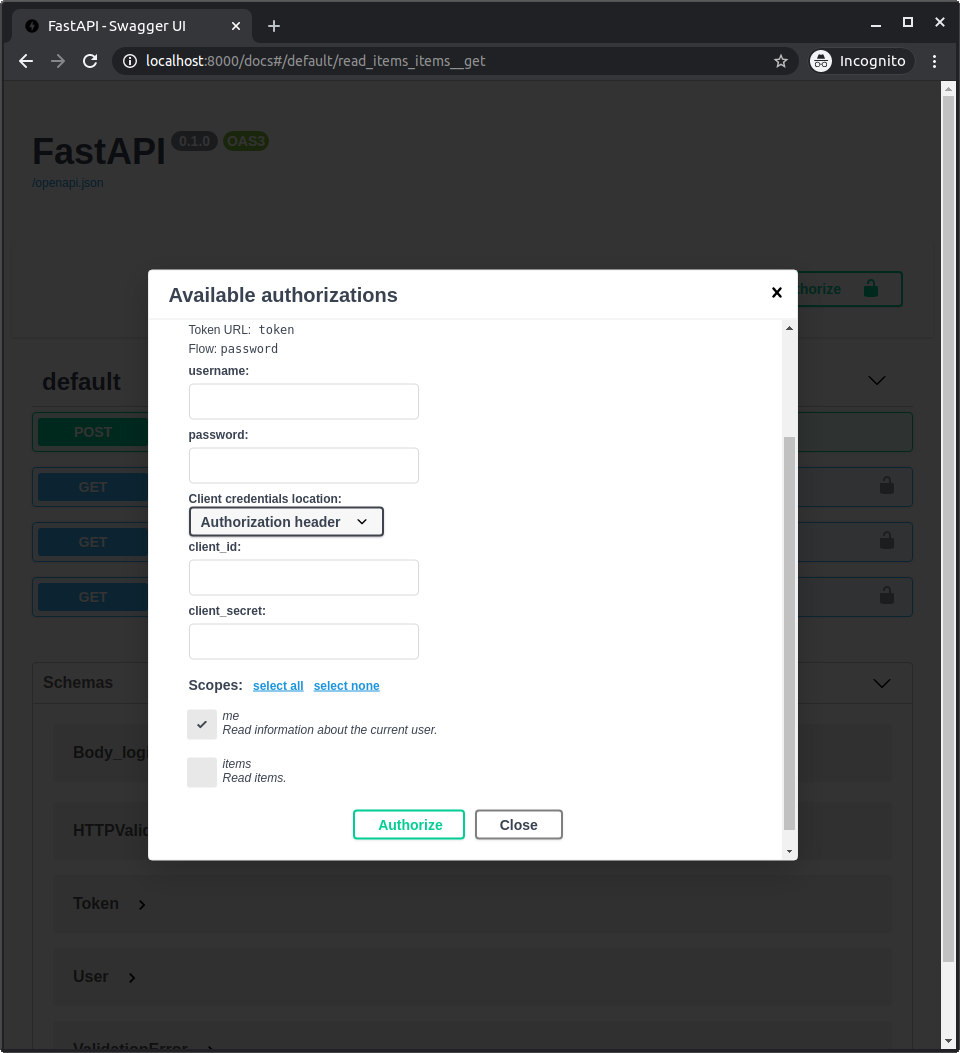
由於現在宣告了這些 scopes,當你登入/授權時,它們會出現在 API 文件中。
你可以選擇要授予哪些 scopes 存取權:me 與 items。
這與你使用 Facebook、Google、GitHub 等登入時所授與權限的機制相同:
內含 scopes 的 JWT token
現在,修改 token 的路徑操作以回傳所請求的 scopes。
我們仍然使用相同的 OAuth2PasswordRequestForm。它包含屬性 scopes,其為 list 的 str,列出請求中收到的每個 scope。
並且我們將這些 scopes 作為 JWT token 的一部分回傳。
Danger
為了簡化,這裡我們只是直接把接收到的 scopes 加進 token。
但在你的應用中,為了安全性,你應確保只加入該使用者實際可擁有或你預先定義的 scopes。
from datetime import datetime, timedelta, timezone
from typing import Annotated

import jwt
from fastapi import Depends, FastAPI, HTTPException, Security, status
from fastapi.security import (
    OAuth2PasswordBearer,
    OAuth2PasswordRequestForm,
    SecurityScopes,
)
from jwt.exceptions import InvalidTokenError
from pwdlib import PasswordHash
from pydantic import BaseModel, ValidationError

# to get a string like this run:
# openssl rand -hex 32
SECRET_KEY = "09d25e094faa6ca2556c818166b7a9563b93f7099f6f0f4caa6cf63b88e8d3e7"
ALGORITHM = "HS256"
ACCESS_TOKEN_EXPIRE_MINUTES = 30


fake_users_db = {
    "johndoe": {
        "username": "johndoe",
        "full_name": "John Doe",
        "email": "johndoe@example.com",
        "hashed_password": "$argon2id$v=19$m=65536,t=3,p=4$wagCPXjifgvUFBzq4hqe3w$CYaIb8sB+wtD+Vu/P4uod1+Qof8h+1g7bbDlBID48Rc",
        "disabled": False,
    },
    "alice": {
        "username": "alice",
        "full_name": "Alice Chains",
        "email": "alicechains@example.com",
        "hashed_password": "$argon2id$v=19$m=65536,t=3,p=4$g2/AV1zwopqUntPKJavBFw$BwpRGDCyUHLvHICnwijyX8ROGoiUPwNKZ7915MeYfCE",
        "disabled": True,
    },
}


class Token(BaseModel):
    access_token: str
    token_type: str


class TokenData(BaseModel):
    username: str | None = None
    scopes: list[str] = []


class User(BaseModel):
    username: str
    email: str | None = None
    full_name: str | None = None
    disabled: bool | None = None


class UserInDB(User):
    hashed_password: str


password_hash = PasswordHash.recommended()

DUMMY_HASH = password_hash.hash("dummypassword")

oauth2_scheme = OAuth2PasswordBearer(
    tokenUrl="token",
    scopes={"me": "Read information about the current user.", "items": "Read items."},
)

app = FastAPI()


def verify_password(plain_password, hashed_password):
    return password_hash.verify(plain_password, hashed_password)


def get_password_hash(password):
    return password_hash.hash(password)


def get_user(db, username: str):
    if username in db:
        user_dict = db[username]
        return UserInDB(**user_dict)


def authenticate_user(fake_db, username: str, password: str):
    user = get_user(fake_db, username)
    if not user:
        verify_password(password, DUMMY_HASH)
        return False
    if not verify_password(password, user.hashed_password):
        return False
    return user


def create_access_token(data: dict, expires_delta: timedelta | None = None):
    to_encode = data.copy()
    if expires_delta:
        expire = datetime.now(timezone.utc) + expires_delta
    else:
        expire = datetime.now(timezone.utc) + timedelta(minutes=15)
    to_encode.update({"exp": expire})
    encoded_jwt = jwt.encode(to_encode, SECRET_KEY, algorithm=ALGORITHM)
    return encoded_jwt


async def get_current_user(
    security_scopes: SecurityScopes, token: Annotated[str, Depends(oauth2_scheme)]
):
    if security_scopes.scopes:
        authenticate_value = f'Bearer scope="{security_scopes.scope_str}"'
    else:
        authenticate_value = "Bearer"
    credentials_exception = HTTPException(
        status_code=status.HTTP_401_UNAUTHORIZED,
        detail="Could not validate credentials",
        headers={"WWW-Authenticate": authenticate_value},
    )
    try:
        payload = jwt.decode(token, SECRET_KEY, algorithms=[ALGORITHM])
        username = payload.get("sub")
        if username is None:
            raise credentials_exception
        scope: str = payload.get("scope", "")
        token_scopes = scope.split(" ")
        token_data = TokenData(scopes=token_scopes, username=username)
    except (InvalidTokenError, ValidationError):
        raise credentials_exception
    user = get_user(fake_users_db, username=token_data.username)
    if user is None:
        raise credentials_exception
    for scope in security_scopes.scopes:
        if scope not in token_data.scopes:
            raise HTTPException(
                status_code=status.HTTP_401_UNAUTHORIZED,
                detail="Not enough permissions",
                headers={"WWW-Authenticate": authenticate_value},
            )
    return user


async def get_current_active_user(
    current_user: Annotated[User, Security(get_current_user, scopes=["me"])],
):
    if current_user.disabled:
        raise HTTPException(status_code=400, detail="Inactive user")
    return current_user


@app.post("/token")
async def login_for_access_token(
    form_data: Annotated[OAuth2PasswordRequestForm, Depends()],
) -> Token:
    user = authenticate_user(fake_users_db, form_data.username, form_data.password)
    if not user:
        raise HTTPException(status_code=400, detail="Incorrect username or password")
    access_token_expires = timedelta(minutes=ACCESS_TOKEN_EXPIRE_MINUTES)
    access_token = create_access_token(
        data={"sub": user.username, "scope": " ".join(form_data.scopes)},
        expires_delta=access_token_expires,
    )
    return Token(access_token=access_token, token_type="bearer")


@app.get("/users/me/")
async def read_users_me(
    current_user: Annotated[User, Depends(get_current_active_user)],
) -> User:
    return current_user


@app.get("/users/me/items/")
async def read_own_items(
    current_user: Annotated[User, Security(get_current_active_user, scopes=["items"])],
):
    return [{"item_id": "Foo", "owner": current_user.username}]


@app.get("/status/")
async def read_system_status(current_user: Annotated[User, Depends(get_current_user)]):
    return {"status": "ok"}
🤓 Other versions and variants
Tip
Prefer to use the Annotated version if possible.
from datetime import datetime, timedelta, timezone

import jwt
from fastapi import Depends, FastAPI, HTTPException, Security, status
from fastapi.security import (
    OAuth2PasswordBearer,
    OAuth2PasswordRequestForm,
    SecurityScopes,
)
from jwt.exceptions import InvalidTokenError
from pwdlib import PasswordHash
from pydantic import BaseModel, ValidationError

# to get a string like this run:
# openssl rand -hex 32
SECRET_KEY = "09d25e094faa6ca2556c818166b7a9563b93f7099f6f0f4caa6cf63b88e8d3e7"
ALGORITHM = "HS256"
ACCESS_TOKEN_EXPIRE_MINUTES = 30


fake_users_db = {
    "johndoe": {
        "username": "johndoe",
        "full_name": "John Doe",
        "email": "johndoe@example.com",
        "hashed_password": "$argon2id$v=19$m=65536,t=3,p=4$wagCPXjifgvUFBzq4hqe3w$CYaIb8sB+wtD+Vu/P4uod1+Qof8h+1g7bbDlBID48Rc",
        "disabled": False,
    },
    "alice": {
        "username": "alice",
        "full_name": "Alice Chains",
        "email": "alicechains@example.com",
        "hashed_password": "$argon2id$v=19$m=65536,t=3,p=4$g2/AV1zwopqUntPKJavBFw$BwpRGDCyUHLvHICnwijyX8ROGoiUPwNKZ7915MeYfCE",
        "disabled": True,
    },
}


class Token(BaseModel):
    access_token: str
    token_type: str


class TokenData(BaseModel):
    username: str | None = None
    scopes: list[str] = []


class User(BaseModel):
    username: str
    email: str | None = None
    full_name: str | None = None
    disabled: bool | None = None


class UserInDB(User):
    hashed_password: str


password_hash = PasswordHash.recommended()

DUMMY_HASH = password_hash.hash("dummypassword")

oauth2_scheme = OAuth2PasswordBearer(
    tokenUrl="token",
    scopes={"me": "Read information about the current user.", "items": "Read items."},
)

app = FastAPI()


def verify_password(plain_password, hashed_password):
    return password_hash.verify(plain_password, hashed_password)


def get_password_hash(password):
    return password_hash.hash(password)


def get_user(db, username: str):
    if username in db:
        user_dict = db[username]
        return UserInDB(**user_dict)


def authenticate_user(fake_db, username: str, password: str):
    user = get_user(fake_db, username)
    if not user:
        verify_password(password, DUMMY_HASH)
        return False
    if not verify_password(password, user.hashed_password):
        return False
    return user


def create_access_token(data: dict, expires_delta: timedelta | None = None):
    to_encode = data.copy()
    if expires_delta:
        expire = datetime.now(timezone.utc) + expires_delta
    else:
        expire = datetime.now(timezone.utc) + timedelta(minutes=15)
    to_encode.update({"exp": expire})
    encoded_jwt = jwt.encode(to_encode, SECRET_KEY, algorithm=ALGORITHM)
    return encoded_jwt


async def get_current_user(
    security_scopes: SecurityScopes, token: str = Depends(oauth2_scheme)
):
    if security_scopes.scopes:
        authenticate_value = f'Bearer scope="{security_scopes.scope_str}"'
    else:
        authenticate_value = "Bearer"
    credentials_exception = HTTPException(
        status_code=status.HTTP_401_UNAUTHORIZED,
        detail="Could not validate credentials",
        headers={"WWW-Authenticate": authenticate_value},
    )
    try:
        payload = jwt.decode(token, SECRET_KEY, algorithms=[ALGORITHM])
        username: str = payload.get("sub")
        if username is None:
            raise credentials_exception
        scope: str = payload.get("scope", "")
        token_scopes = scope.split(" ")
        token_data = TokenData(scopes=token_scopes, username=username)
    except (InvalidTokenError, ValidationError):
        raise credentials_exception
    user = get_user(fake_users_db, username=token_data.username)
    if user is None:
        raise credentials_exception
    for scope in security_scopes.scopes:
        if scope not in token_data.scopes:
            raise HTTPException(
                status_code=status.HTTP_401_UNAUTHORIZED,
                detail="Not enough permissions",
                headers={"WWW-Authenticate": authenticate_value},
            )
    return user


async def get_current_active_user(
    current_user: User = Security(get_current_user, scopes=["me"]),
):
    if current_user.disabled:
        raise HTTPException(status_code=400, detail="Inactive user")
    return current_user


@app.post("/token")
async def login_for_access_token(
    form_data: OAuth2PasswordRequestForm = Depends(),
) -> Token:
    user = authenticate_user(fake_users_db, form_data.username, form_data.password)
    if not user:
        raise HTTPException(status_code=400, detail="Incorrect username or password")
    access_token_expires = timedelta(minutes=ACCESS_TOKEN_EXPIRE_MINUTES)
    access_token = create_access_token(
        data={"sub": user.username, "scope": " ".join(form_data.scopes)},
        expires_delta=access_token_expires,
    )
    return Token(access_token=access_token, token_type="bearer")


@app.get("/users/me/")
async def read_users_me(current_user: User = Depends(get_current_active_user)) -> User:
    return current_user


@app.get("/users/me/items/")
async def read_own_items(
    current_user: User = Security(get_current_active_user, scopes=["items"]),
):
    return [{"item_id": "Foo", "owner": current_user.username}]


@app.get("/status/")
async def read_system_status(current_user: User = Depends(get_current_user)):
    return {"status": "ok"}
在路徑操作與相依性中宣告 scopes
現在我們宣告 /users/me/items/ 這個路徑操作需要 items 這個 scope。
為此,我們從 fastapi 匯入並使用 Security。
你可以使用 Security 來宣告相依性(就像 Depends),但 Security 也能接收參數 scopes,其為 scopes(字串)的列表。
在這裡,我們將相依函式 get_current_active_user 傳給 Security(就像使用 Depends 一樣)。
但同時也傳入一個 list 的 scopes,這裡只有一個 scope:items(當然也可以有更多)。
而相依函式 get_current_active_user 也能宣告子相依性,不只用 Depends,也能用 Security。它宣告了自己的子相依函式(get_current_user),並加入更多 scope 要求。
在這個例子中,它要求 me 這個 scope(也可以要求多個)。
Note
你不一定需要在不同地方加上不同的 scopes。
我們在這裡這樣做,是為了示範 FastAPI 如何處理在不同層級宣告的 scopes。
from datetime import datetime, timedelta, timezone
from typing import Annotated

import jwt
from fastapi import Depends, FastAPI, HTTPException, Security, status
from fastapi.security import (
    OAuth2PasswordBearer,
    OAuth2PasswordRequestForm,
    SecurityScopes,
)
from jwt.exceptions import InvalidTokenError
from pwdlib import PasswordHash
from pydantic import BaseModel, ValidationError

# to get a string like this run:
# openssl rand -hex 32
SECRET_KEY = "09d25e094faa6ca2556c818166b7a9563b93f7099f6f0f4caa6cf63b88e8d3e7"
ALGORITHM = "HS256"
ACCESS_TOKEN_EXPIRE_MINUTES = 30


fake_users_db = {
    "johndoe": {
        "username": "johndoe",
        "full_name": "John Doe",
        "email": "johndoe@example.com",
        "hashed_password": "$argon2id$v=19$m=65536,t=3,p=4$wagCPXjifgvUFBzq4hqe3w$CYaIb8sB+wtD+Vu/P4uod1+Qof8h+1g7bbDlBID48Rc",
        "disabled": False,
    },
    "alice": {
        "username": "alice",
        "full_name": "Alice Chains",
        "email": "alicechains@example.com",
        "hashed_password": "$argon2id$v=19$m=65536,t=3,p=4$g2/AV1zwopqUntPKJavBFw$BwpRGDCyUHLvHICnwijyX8ROGoiUPwNKZ7915MeYfCE",
        "disabled": True,
    },
}


class Token(BaseModel):
    access_token: str
    token_type: str


class TokenData(BaseModel):
    username: str | None = None
    scopes: list[str] = []


class User(BaseModel):
    username: str
    email: str | None = None
    full_name: str | None = None
    disabled: bool | None = None


class UserInDB(User):
    hashed_password: str


password_hash = PasswordHash.recommended()

DUMMY_HASH = password_hash.hash("dummypassword")

oauth2_scheme = OAuth2PasswordBearer(
    tokenUrl="token",
    scopes={"me": "Read information about the current user.", "items": "Read items."},
)

app = FastAPI()


def verify_password(plain_password, hashed_password):
    return password_hash.verify(plain_password, hashed_password)


def get_password_hash(password):
    return password_hash.hash(password)


def get_user(db, username: str):
    if username in db:
        user_dict = db[username]
        return UserInDB(**user_dict)


def authenticate_user(fake_db, username: str, password: str):
    user = get_user(fake_db, username)
    if not user:
        verify_password(password, DUMMY_HASH)
        return False
    if not verify_password(password, user.hashed_password):
        return False
    return user


def create_access_token(data: dict, expires_delta: timedelta | None = None):
    to_encode = data.copy()
    if expires_delta:
        expire = datetime.now(timezone.utc) + expires_delta
    else:
        expire = datetime.now(timezone.utc) + timedelta(minutes=15)
    to_encode.update({"exp": expire})
    encoded_jwt = jwt.encode(to_encode, SECRET_KEY, algorithm=ALGORITHM)
    return encoded_jwt


async def get_current_user(
    security_scopes: SecurityScopes, token: Annotated[str, Depends(oauth2_scheme)]
):
    if security_scopes.scopes:
        authenticate_value = f'Bearer scope="{security_scopes.scope_str}"'
    else:
        authenticate_value = "Bearer"
    credentials_exception = HTTPException(
        status_code=status.HTTP_401_UNAUTHORIZED,
        detail="Could not validate credentials",
        headers={"WWW-Authenticate": authenticate_value},
    )
    try:
        payload = jwt.decode(token, SECRET_KEY, algorithms=[ALGORITHM])
        username = payload.get("sub")
        if username is None:
            raise credentials_exception
        scope: str = payload.get("scope", "")
        token_scopes = scope.split(" ")
        token_data = TokenData(scopes=token_scopes, username=username)
    except (InvalidTokenError, ValidationError):
        raise credentials_exception
    user = get_user(fake_users_db, username=token_data.username)
    if user is None:
        raise credentials_exception
    for scope in security_scopes.scopes:
        if scope not in token_data.scopes:
            raise HTTPException(
                status_code=status.HTTP_401_UNAUTHORIZED,
                detail="Not enough permissions",
                headers={"WWW-Authenticate": authenticate_value},
            )
    return user


async def get_current_active_user(
    current_user: Annotated[User, Security(get_current_user, scopes=["me"])],
):
    if current_user.disabled:
        raise HTTPException(status_code=400, detail="Inactive user")
    return current_user


@app.post("/token")
async def login_for_access_token(
    form_data: Annotated[OAuth2PasswordRequestForm, Depends()],
) -> Token:
    user = authenticate_user(fake_users_db, form_data.username, form_data.password)
    if not user:
        raise HTTPException(status_code=400, detail="Incorrect username or password")
    access_token_expires = timedelta(minutes=ACCESS_TOKEN_EXPIRE_MINUTES)
    access_token = create_access_token(
        data={"sub": user.username, "scope": " ".join(form_data.scopes)},
        expires_delta=access_token_expires,
    )
    return Token(access_token=access_token, token_type="bearer")


@app.get("/users/me/")
async def read_users_me(
    current_user: Annotated[User, Depends(get_current_active_user)],
) -> User:
    return current_user


@app.get("/users/me/items/")
async def read_own_items(
    current_user: Annotated[User, Security(get_current_active_user, scopes=["items"])],
):
    return [{"item_id": "Foo", "owner": current_user.username}]


@app.get("/status/")
async def read_system_status(current_user: Annotated[User, Depends(get_current_user)]):
    return {"status": "ok"}
🤓 Other versions and variants
Tip
Prefer to use the Annotated version if possible.
from datetime import datetime, timedelta, timezone

import jwt
from fastapi import Depends, FastAPI, HTTPException, Security, status
from fastapi.security import (
    OAuth2PasswordBearer,
    OAuth2PasswordRequestForm,
    SecurityScopes,
)
from jwt.exceptions import InvalidTokenError
from pwdlib import PasswordHash
from pydantic import BaseModel, ValidationError

# to get a string like this run:
# openssl rand -hex 32
SECRET_KEY = "09d25e094faa6ca2556c818166b7a9563b93f7099f6f0f4caa6cf63b88e8d3e7"
ALGORITHM = "HS256"
ACCESS_TOKEN_EXPIRE_MINUTES = 30


fake_users_db = {
    "johndoe": {
        "username": "johndoe",
        "full_name": "John Doe",
        "email": "johndoe@example.com",
        "hashed_password": "$argon2id$v=19$m=65536,t=3,p=4$wagCPXjifgvUFBzq4hqe3w$CYaIb8sB+wtD+Vu/P4uod1+Qof8h+1g7bbDlBID48Rc",
        "disabled": False,
    },
    "alice": {
        "username": "alice",
        "full_name": "Alice Chains",
        "email": "alicechains@example.com",
        "hashed_password": "$argon2id$v=19$m=65536,t=3,p=4$g2/AV1zwopqUntPKJavBFw$BwpRGDCyUHLvHICnwijyX8ROGoiUPwNKZ7915MeYfCE",
        "disabled": True,
    },
}


class Token(BaseModel):
    access_token: str
    token_type: str


class TokenData(BaseModel):
    username: str | None = None
    scopes: list[str] = []


class User(BaseModel):
    username: str
    email: str | None = None
    full_name: str | None = None
    disabled: bool | None = None


class UserInDB(User):
    hashed_password: str


password_hash = PasswordHash.recommended()

DUMMY_HASH = password_hash.hash("dummypassword")

oauth2_scheme = OAuth2PasswordBearer(
    tokenUrl="token",
    scopes={"me": "Read information about the current user.", "items": "Read items."},
)

app = FastAPI()


def verify_password(plain_password, hashed_password):
    return password_hash.verify(plain_password, hashed_password)


def get_password_hash(password):
    return password_hash.hash(password)


def get_user(db, username: str):
    if username in db:
        user_dict = db[username]
        return UserInDB(**user_dict)


def authenticate_user(fake_db, username: str, password: str):
    user = get_user(fake_db, username)
    if not user:
        verify_password(password, DUMMY_HASH)
        return False
    if not verify_password(password, user.hashed_password):
        return False
    return user


def create_access_token(data: dict, expires_delta: timedelta | None = None):
    to_encode = data.copy()
    if expires_delta:
        expire = datetime.now(timezone.utc) + expires_delta
    else:
        expire = datetime.now(timezone.utc) + timedelta(minutes=15)
    to_encode.update({"exp": expire})
    encoded_jwt = jwt.encode(to_encode, SECRET_KEY, algorithm=ALGORITHM)
    return encoded_jwt


async def get_current_user(
    security_scopes: SecurityScopes, token: str = Depends(oauth2_scheme)
):
    if security_scopes.scopes:
        authenticate_value = f'Bearer scope="{security_scopes.scope_str}"'
    else:
        authenticate_value = "Bearer"
    credentials_exception = HTTPException(
        status_code=status.HTTP_401_UNAUTHORIZED,
        detail="Could not validate credentials",
        headers={"WWW-Authenticate": authenticate_value},
    )
    try:
        payload = jwt.decode(token, SECRET_KEY, algorithms=[ALGORITHM])
        username: str = payload.get("sub")
        if username is None:
            raise credentials_exception
        scope: str = payload.get("scope", "")
        token_scopes = scope.split(" ")
        token_data = TokenData(scopes=token_scopes, username=username)
    except (InvalidTokenError, ValidationError):
        raise credentials_exception
    user = get_user(fake_users_db, username=token_data.username)
    if user is None:
        raise credentials_exception
    for scope in security_scopes.scopes:
        if scope not in token_data.scopes:
            raise HTTPException(
                status_code=status.HTTP_401_UNAUTHORIZED,
                detail="Not enough permissions",
                headers={"WWW-Authenticate": authenticate_value},
            )
    return user


async def get_current_active_user(
    current_user: User = Security(get_current_user, scopes=["me"]),
):
    if current_user.disabled:
        raise HTTPException(status_code=400, detail="Inactive user")
    return current_user


@app.post("/token")
async def login_for_access_token(
    form_data: OAuth2PasswordRequestForm = Depends(),
) -> Token:
    user = authenticate_user(fake_users_db, form_data.username, form_data.password)
    if not user:
        raise HTTPException(status_code=400, detail="Incorrect username or password")
    access_token_expires = timedelta(minutes=ACCESS_TOKEN_EXPIRE_MINUTES)
    access_token = create_access_token(
        data={"sub": user.username, "scope": " ".join(form_data.scopes)},
        expires_delta=access_token_expires,
    )
    return Token(access_token=access_token, token_type="bearer")


@app.get("/users/me/")
async def read_users_me(current_user: User = Depends(get_current_active_user)) -> User:
    return current_user


@app.get("/users/me/items/")
async def read_own_items(
    current_user: User = Security(get_current_active_user, scopes=["items"]),
):
    return [{"item_id": "Foo", "owner": current_user.username}]


@app.get("/status/")
async def read_system_status(current_user: User = Depends(get_current_user)):
    return {"status": "ok"}
技術細節
Security 其實是 Depends 的子類別,僅多了一個我們稍後會看到的參數。
改用 Security 而不是 Depends,能讓 FastAPI 知道可以宣告安全性 scopes、在內部使用它們,並用 OpenAPI 文件化 API。
另外,當你從 fastapi 匯入 Query、Path、Depends、Security 等時,實際上它們是回傳特殊類別的函式。
使用 SecurityScopes
現在更新相依性 get_current_user。
上面的相依性就是使用它。
這裡我們使用先前建立的相同 OAuth2 scheme,並將其宣告為相依性:oauth2_scheme。
因為此相依函式本身沒有任何 scope 要求,所以我們可以用 Depends 搭配 oauth2_scheme,當不需要指定安全性 scopes 時就不必用 Security。
我們也宣告了一個型別為 SecurityScopes 的特殊參數,從 fastapi.security 匯入。
這個 SecurityScopes 類似於 Request(Request 用來直接取得請求物件)。
from datetime import datetime, timedelta, timezone
from typing import Annotated

import jwt
from fastapi import Depends, FastAPI, HTTPException, Security, status
from fastapi.security import (
    OAuth2PasswordBearer,
    OAuth2PasswordRequestForm,
    SecurityScopes,
)
from jwt.exceptions import InvalidTokenError
from pwdlib import PasswordHash
from pydantic import BaseModel, ValidationError

# to get a string like this run:
# openssl rand -hex 32
SECRET_KEY = "09d25e094faa6ca2556c818166b7a9563b93f7099f6f0f4caa6cf63b88e8d3e7"
ALGORITHM = "HS256"
ACCESS_TOKEN_EXPIRE_MINUTES = 30


fake_users_db = {
    "johndoe": {
        "username": "johndoe",
        "full_name": "John Doe",
        "email": "johndoe@example.com",
        "hashed_password": "$argon2id$v=19$m=65536,t=3,p=4$wagCPXjifgvUFBzq4hqe3w$CYaIb8sB+wtD+Vu/P4uod1+Qof8h+1g7bbDlBID48Rc",
        "disabled": False,
    },
    "alice": {
        "username": "alice",
        "full_name": "Alice Chains",
        "email": "alicechains@example.com",
        "hashed_password": "$argon2id$v=19$m=65536,t=3,p=4$g2/AV1zwopqUntPKJavBFw$BwpRGDCyUHLvHICnwijyX8ROGoiUPwNKZ7915MeYfCE",
        "disabled": True,
    },
}


class Token(BaseModel):
    access_token: str
    token_type: str


class TokenData(BaseModel):
    username: str | None = None
    scopes: list[str] = []


class User(BaseModel):
    username: str
    email: str | None = None
    full_name: str | None = None
    disabled: bool | None = None


class UserInDB(User):
    hashed_password: str


password_hash = PasswordHash.recommended()

DUMMY_HASH = password_hash.hash("dummypassword")

oauth2_scheme = OAuth2PasswordBearer(
    tokenUrl="token",
    scopes={"me": "Read information about the current user.", "items": "Read items."},
)

app = FastAPI()


def verify_password(plain_password, hashed_password):
    return password_hash.verify(plain_password, hashed_password)


def get_password_hash(password):
    return password_hash.hash(password)


def get_user(db, username: str):
    if username in db:
        user_dict = db[username]
        return UserInDB(**user_dict)


def authenticate_user(fake_db, username: str, password: str):
    user = get_user(fake_db, username)
    if not user:
        verify_password(password, DUMMY_HASH)
        return False
    if not verify_password(password, user.hashed_password):
        return False
    return user


def create_access_token(data: dict, expires_delta: timedelta | None = None):
    to_encode = data.copy()
    if expires_delta:
        expire = datetime.now(timezone.utc) + expires_delta
    else:
        expire = datetime.now(timezone.utc) + timedelta(minutes=15)
    to_encode.update({"exp": expire})
    encoded_jwt = jwt.encode(to_encode, SECRET_KEY, algorithm=ALGORITHM)
    return encoded_jwt


async def get_current_user(
    security_scopes: SecurityScopes, token: Annotated[str, Depends(oauth2_scheme)]
):
    if security_scopes.scopes:
        authenticate_value = f'Bearer scope="{security_scopes.scope_str}"'
    else:
        authenticate_value = "Bearer"
    credentials_exception = HTTPException(
        status_code=status.HTTP_401_UNAUTHORIZED,
        detail="Could not validate credentials",
        headers={"WWW-Authenticate": authenticate_value},
    )
    try:
        payload = jwt.decode(token, SECRET_KEY, algorithms=[ALGORITHM])
        username = payload.get("sub")
        if username is None:
            raise credentials_exception
        scope: str = payload.get("scope", "")
        token_scopes = scope.split(" ")
        token_data = TokenData(scopes=token_scopes, username=username)
    except (InvalidTokenError, ValidationError):
        raise credentials_exception
    user = get_user(fake_users_db, username=token_data.username)
    if user is None:
        raise credentials_exception
    for scope in security_scopes.scopes:
        if scope not in token_data.scopes:
            raise HTTPException(
                status_code=status.HTTP_401_UNAUTHORIZED,
                detail="Not enough permissions",
                headers={"WWW-Authenticate": authenticate_value},
            )
    return user


async def get_current_active_user(
    current_user: Annotated[User, Security(get_current_user, scopes=["me"])],
):
    if current_user.disabled:
        raise HTTPException(status_code=400, detail="Inactive user")
    return current_user


@app.post("/token")
async def login_for_access_token(
    form_data: Annotated[OAuth2PasswordRequestForm, Depends()],
) -> Token:
    user = authenticate_user(fake_users_db, form_data.username, form_data.password)
    if not user:
        raise HTTPException(status_code=400, detail="Incorrect username or password")
    access_token_expires = timedelta(minutes=ACCESS_TOKEN_EXPIRE_MINUTES)
    access_token = create_access_token(
        data={"sub": user.username, "scope": " ".join(form_data.scopes)},
        expires_delta=access_token_expires,
    )
    return Token(access_token=access_token, token_type="bearer")


@app.get("/users/me/")
async def read_users_me(
    current_user: Annotated[User, Depends(get_current_active_user)],
) -> User:
    return current_user


@app.get("/users/me/items/")
async def read_own_items(
    current_user: Annotated[User, Security(get_current_active_user, scopes=["items"])],
):
    return [{"item_id": "Foo", "owner": current_user.username}]


@app.get("/status/")
async def read_system_status(current_user: Annotated[User, Depends(get_current_user)]):
    return {"status": "ok"}
🤓 Other versions and variants
Tip
Prefer to use the Annotated version if possible.
from datetime import datetime, timedelta, timezone

import jwt
from fastapi import Depends, FastAPI, HTTPException, Security, status
from fastapi.security import (
    OAuth2PasswordBearer,
    OAuth2PasswordRequestForm,
    SecurityScopes,
)
from jwt.exceptions import InvalidTokenError
from pwdlib import PasswordHash
from pydantic import BaseModel, ValidationError

# to get a string like this run:
# openssl rand -hex 32
SECRET_KEY = "09d25e094faa6ca2556c818166b7a9563b93f7099f6f0f4caa6cf63b88e8d3e7"
ALGORITHM = "HS256"
ACCESS_TOKEN_EXPIRE_MINUTES = 30


fake_users_db = {
    "johndoe": {
        "username": "johndoe",
        "full_name": "John Doe",
        "email": "johndoe@example.com",
        "hashed_password": "$argon2id$v=19$m=65536,t=3,p=4$wagCPXjifgvUFBzq4hqe3w$CYaIb8sB+wtD+Vu/P4uod1+Qof8h+1g7bbDlBID48Rc",
        "disabled": False,
    },
    "alice": {
        "username": "alice",
        "full_name": "Alice Chains",
        "email": "alicechains@example.com",
        "hashed_password": "$argon2id$v=19$m=65536,t=3,p=4$g2/AV1zwopqUntPKJavBFw$BwpRGDCyUHLvHICnwijyX8ROGoiUPwNKZ7915MeYfCE",
        "disabled": True,
    },
}


class Token(BaseModel):
    access_token: str
    token_type: str


class TokenData(BaseModel):
    username: str | None = None
    scopes: list[str] = []


class User(BaseModel):
    username: str
    email: str | None = None
    full_name: str | None = None
    disabled: bool | None = None


class UserInDB(User):
    hashed_password: str


password_hash = PasswordHash.recommended()

DUMMY_HASH = password_hash.hash("dummypassword")

oauth2_scheme = OAuth2PasswordBearer(
    tokenUrl="token",
    scopes={"me": "Read information about the current user.", "items": "Read items."},
)

app = FastAPI()


def verify_password(plain_password, hashed_password):
    return password_hash.verify(plain_password, hashed_password)


def get_password_hash(password):
    return password_hash.hash(password)


def get_user(db, username: str):
    if username in db:
        user_dict = db[username]
        return UserInDB(**user_dict)


def authenticate_user(fake_db, username: str, password: str):
    user = get_user(fake_db, username)
    if not user:
        verify_password(password, DUMMY_HASH)
        return False
    if not verify_password(password, user.hashed_password):
        return False
    return user


def create_access_token(data: dict, expires_delta: timedelta | None = None):
    to_encode = data.copy()
    if expires_delta:
        expire = datetime.now(timezone.utc) + expires_delta
    else:
        expire = datetime.now(timezone.utc) + timedelta(minutes=15)
    to_encode.update({"exp": expire})
    encoded_jwt = jwt.encode(to_encode, SECRET_KEY, algorithm=ALGORITHM)
    return encoded_jwt


async def get_current_user(
    security_scopes: SecurityScopes, token: str = Depends(oauth2_scheme)
):
    if security_scopes.scopes:
        authenticate_value = f'Bearer scope="{security_scopes.scope_str}"'
    else:
        authenticate_value = "Bearer"
    credentials_exception = HTTPException(
        status_code=status.HTTP_401_UNAUTHORIZED,
        detail="Could not validate credentials",
        headers={"WWW-Authenticate": authenticate_value},
    )
    try:
        payload = jwt.decode(token, SECRET_KEY, algorithms=[ALGORITHM])
        username: str = payload.get("sub")
        if username is None:
            raise credentials_exception
        scope: str = payload.get("scope", "")
        token_scopes = scope.split(" ")
        token_data = TokenData(scopes=token_scopes, username=username)
    except (InvalidTokenError, ValidationError):
        raise credentials_exception
    user = get_user(fake_users_db, username=token_data.username)
    if user is None:
        raise credentials_exception
    for scope in security_scopes.scopes:
        if scope not in token_data.scopes:
            raise HTTPException(
                status_code=status.HTTP_401_UNAUTHORIZED,
                detail="Not enough permissions",
                headers={"WWW-Authenticate": authenticate_value},
            )
    return user


async def get_current_active_user(
    current_user: User = Security(get_current_user, scopes=["me"]),
):
    if current_user.disabled:
        raise HTTPException(status_code=400, detail="Inactive user")
    return current_user


@app.post("/token")
async def login_for_access_token(
    form_data: OAuth2PasswordRequestForm = Depends(),
) -> Token:
    user = authenticate_user(fake_users_db, form_data.username, form_data.password)
    if not user:
        raise HTTPException(status_code=400, detail="Incorrect username or password")
    access_token_expires = timedelta(minutes=ACCESS_TOKEN_EXPIRE_MINUTES)
    access_token = create_access_token(
        data={"sub": user.username, "scope": " ".join(form_data.scopes)},
        expires_delta=access_token_expires,
    )
    return Token(access_token=access_token, token_type="bearer")


@app.get("/users/me/")
async def read_users_me(current_user: User = Depends(get_current_active_user)) -> User:
    return current_user


@app.get("/users/me/items/")
async def read_own_items(
    current_user: User = Security(get_current_active_user, scopes=["items"]),
):
    return [{"item_id": "Foo", "owner": current_user.username}]


@app.get("/status/")
async def read_system_status(current_user: User = Depends(get_current_user)):
    return {"status": "ok"}
使用這些 scopes
參數 security_scopes 的型別是 SecurityScopes。
它會有屬性 scopes,包含一個列表,內含此函式本身與所有使用它為子相依性的相依性所要求的所有 scopes。也就是所有「相依者(dependants)」... 這聽起來可能有點混亂,下面會再解釋。
security_scopes 物件(類別 SecurityScopes)也提供 scope_str 屬性,為一個字串,包含那些以空白分隔的 scopes(我們會用到)。
我們建立一個可在多處重複丟出(raise)的 HTTPException。
在這個例外中,我們把所需的 scopes(若有)以空白分隔的字串形式(透過 scope_str)加入,並將該包含 scopes 的字串放在 WWW-Authenticate 標頭中(這是規格的一部分)。
from datetime import datetime, timedelta, timezone
from typing import Annotated

import jwt
from fastapi import Depends, FastAPI, HTTPException, Security, status
from fastapi.security import (
    OAuth2PasswordBearer,
    OAuth2PasswordRequestForm,
    SecurityScopes,
)
from jwt.exceptions import InvalidTokenError
from pwdlib import PasswordHash
from pydantic import BaseModel, ValidationError

# to get a string like this run:
# openssl rand -hex 32
SECRET_KEY = "09d25e094faa6ca2556c818166b7a9563b93f7099f6f0f4caa6cf63b88e8d3e7"
ALGORITHM = "HS256"
ACCESS_TOKEN_EXPIRE_MINUTES = 30


fake_users_db = {
    "johndoe": {
        "username": "johndoe",
        "full_name": "John Doe",
        "email": "johndoe@example.com",
        "hashed_password": "$argon2id$v=19$m=65536,t=3,p=4$wagCPXjifgvUFBzq4hqe3w$CYaIb8sB+wtD+Vu/P4uod1+Qof8h+1g7bbDlBID48Rc",
        "disabled": False,
    },
    "alice": {
        "username": "alice",
        "full_name": "Alice Chains",
        "email": "alicechains@example.com",
        "hashed_password": "$argon2id$v=19$m=65536,t=3,p=4$g2/AV1zwopqUntPKJavBFw$BwpRGDCyUHLvHICnwijyX8ROGoiUPwNKZ7915MeYfCE",
        "disabled": True,
    },
}


class Token(BaseModel):
    access_token: str
    token_type: str


class TokenData(BaseModel):
    username: str | None = None
    scopes: list[str] = []


class User(BaseModel):
    username: str
    email: str | None = None
    full_name: str | None = None
    disabled: bool | None = None


class UserInDB(User):
    hashed_password: str


password_hash = PasswordHash.recommended()

DUMMY_HASH = password_hash.hash("dummypassword")

oauth2_scheme = OAuth2PasswordBearer(
    tokenUrl="token",
    scopes={"me": "Read information about the current user.", "items": "Read items."},
)

app = FastAPI()


def verify_password(plain_password, hashed_password):
    return password_hash.verify(plain_password, hashed_password)


def get_password_hash(password):
    return password_hash.hash(password)


def get_user(db, username: str):
    if username in db:
        user_dict = db[username]
        return UserInDB(**user_dict)


def authenticate_user(fake_db, username: str, password: str):
    user = get_user(fake_db, username)
    if not user:
        verify_password(password, DUMMY_HASH)
        return False
    if not verify_password(password, user.hashed_password):
        return False
    return user


def create_access_token(data: dict, expires_delta: timedelta | None = None):
    to_encode = data.copy()
    if expires_delta:
        expire = datetime.now(timezone.utc) + expires_delta
    else:
        expire = datetime.now(timezone.utc) + timedelta(minutes=15)
    to_encode.update({"exp": expire})
    encoded_jwt = jwt.encode(to_encode, SECRET_KEY, algorithm=ALGORITHM)
    return encoded_jwt


async def get_current_user(
    security_scopes: SecurityScopes, token: Annotated[str, Depends(oauth2_scheme)]
):
    if security_scopes.scopes:
        authenticate_value = f'Bearer scope="{security_scopes.scope_str}"'
    else:
        authenticate_value = "Bearer"
    credentials_exception = HTTPException(
        status_code=status.HTTP_401_UNAUTHORIZED,
        detail="Could not validate credentials",
        headers={"WWW-Authenticate": authenticate_value},
    )
    try:
        payload = jwt.decode(token, SECRET_KEY, algorithms=[ALGORITHM])
        username = payload.get("sub")
        if username is None:
            raise credentials_exception
        scope: str = payload.get("scope", "")
        token_scopes = scope.split(" ")
        token_data = TokenData(scopes=token_scopes, username=username)
    except (InvalidTokenError, ValidationError):
        raise credentials_exception
    user = get_user(fake_users_db, username=token_data.username)
    if user is None:
        raise credentials_exception
    for scope in security_scopes.scopes:
        if scope not in token_data.scopes:
            raise HTTPException(
                status_code=status.HTTP_401_UNAUTHORIZED,
                detail="Not enough permissions",
                headers={"WWW-Authenticate": authenticate_value},
            )
    return user


async def get_current_active_user(
    current_user: Annotated[User, Security(get_current_user, scopes=["me"])],
):
    if current_user.disabled:
        raise HTTPException(status_code=400, detail="Inactive user")
    return current_user


@app.post("/token")
async def login_for_access_token(
    form_data: Annotated[OAuth2PasswordRequestForm, Depends()],
) -> Token:
    user = authenticate_user(fake_users_db, form_data.username, form_data.password)
    if not user:
        raise HTTPException(status_code=400, detail="Incorrect username or password")
    access_token_expires = timedelta(minutes=ACCESS_TOKEN_EXPIRE_MINUTES)
    access_token = create_access_token(
        data={"sub": user.username, "scope": " ".join(form_data.scopes)},
        expires_delta=access_token_expires,
    )
    return Token(access_token=access_token, token_type="bearer")


@app.get("/users/me/")
async def read_users_me(
    current_user: Annotated[User, Depends(get_current_active_user)],
) -> User:
    return current_user


@app.get("/users/me/items/")
async def read_own_items(
    current_user: Annotated[User, Security(get_current_active_user, scopes=["items"])],
):
    return [{"item_id": "Foo", "owner": current_user.username}]


@app.get("/status/")
async def read_system_status(current_user: Annotated[User, Depends(get_current_user)]):
    return {"status": "ok"}
🤓 Other versions and variants
Tip
Prefer to use the Annotated version if possible.
from datetime import datetime, timedelta, timezone

import jwt
from fastapi import Depends, FastAPI, HTTPException, Security, status
from fastapi.security import (
    OAuth2PasswordBearer,
    OAuth2PasswordRequestForm,
    SecurityScopes,
)
from jwt.exceptions import InvalidTokenError
from pwdlib import PasswordHash
from pydantic import BaseModel, ValidationError

# to get a string like this run:
# openssl rand -hex 32
SECRET_KEY = "09d25e094faa6ca2556c818166b7a9563b93f7099f6f0f4caa6cf63b88e8d3e7"
ALGORITHM = "HS256"
ACCESS_TOKEN_EXPIRE_MINUTES = 30


fake_users_db = {
    "johndoe": {
        "username": "johndoe",
        "full_name": "John Doe",
        "email": "johndoe@example.com",
        "hashed_password": "$argon2id$v=19$m=65536,t=3,p=4$wagCPXjifgvUFBzq4hqe3w$CYaIb8sB+wtD+Vu/P4uod1+Qof8h+1g7bbDlBID48Rc",
        "disabled": False,
    },
    "alice": {
        "username": "alice",
        "full_name": "Alice Chains",
        "email": "alicechains@example.com",
        "hashed_password": "$argon2id$v=19$m=65536,t=3,p=4$g2/AV1zwopqUntPKJavBFw$BwpRGDCyUHLvHICnwijyX8ROGoiUPwNKZ7915MeYfCE",
        "disabled": True,
    },
}


class Token(BaseModel):
    access_token: str
    token_type: str


class TokenData(BaseModel):
    username: str | None = None
    scopes: list[str] = []


class User(BaseModel):
    username: str
    email: str | None = None
    full_name: str | None = None
    disabled: bool | None = None


class UserInDB(User):
    hashed_password: str


password_hash = PasswordHash.recommended()

DUMMY_HASH = password_hash.hash("dummypassword")

oauth2_scheme = OAuth2PasswordBearer(
    tokenUrl="token",
    scopes={"me": "Read information about the current user.", "items": "Read items."},
)

app = FastAPI()


def verify_password(plain_password, hashed_password):
    return password_hash.verify(plain_password, hashed_password)


def get_password_hash(password):
    return password_hash.hash(password)


def get_user(db, username: str):
    if username in db:
        user_dict = db[username]
        return UserInDB(**user_dict)


def authenticate_user(fake_db, username: str, password: str):
    user = get_user(fake_db, username)
    if not user:
        verify_password(password, DUMMY_HASH)
        return False
    if not verify_password(password, user.hashed_password):
        return False
    return user


def create_access_token(data: dict, expires_delta: timedelta | None = None):
    to_encode = data.copy()
    if expires_delta:
        expire = datetime.now(timezone.utc) + expires_delta
    else:
        expire = datetime.now(timezone.utc) + timedelta(minutes=15)
    to_encode.update({"exp": expire})
    encoded_jwt = jwt.encode(to_encode, SECRET_KEY, algorithm=ALGORITHM)
    return encoded_jwt


async def get_current_user(
    security_scopes: SecurityScopes, token: str = Depends(oauth2_scheme)
):
    if security_scopes.scopes:
        authenticate_value = f'Bearer scope="{security_scopes.scope_str}"'
    else:
        authenticate_value = "Bearer"
    credentials_exception = HTTPException(
        status_code=status.HTTP_401_UNAUTHORIZED,
        detail="Could not validate credentials",
        headers={"WWW-Authenticate": authenticate_value},
    )
    try:
        payload = jwt.decode(token, SECRET_KEY, algorithms=[ALGORITHM])
        username: str = payload.get("sub")
        if username is None:
            raise credentials_exception
        scope: str = payload.get("scope", "")
        token_scopes = scope.split(" ")
        token_data = TokenData(scopes=token_scopes, username=username)
    except (InvalidTokenError, ValidationError):
        raise credentials_exception
    user = get_user(fake_users_db, username=token_data.username)
    if user is None:
        raise credentials_exception
    for scope in security_scopes.scopes:
        if scope not in token_data.scopes:
            raise HTTPException(
                status_code=status.HTTP_401_UNAUTHORIZED,
                detail="Not enough permissions",
                headers={"WWW-Authenticate": authenticate_value},
            )
    return user


async def get_current_active_user(
    current_user: User = Security(get_current_user, scopes=["me"]),
):
    if current_user.disabled:
        raise HTTPException(status_code=400, detail="Inactive user")
    return current_user


@app.post("/token")
async def login_for_access_token(
    form_data: OAuth2PasswordRequestForm = Depends(),
) -> Token:
    user = authenticate_user(fake_users_db, form_data.username, form_data.password)
    if not user:
        raise HTTPException(status_code=400, detail="Incorrect username or password")
    access_token_expires = timedelta(minutes=ACCESS_TOKEN_EXPIRE_MINUTES)
    access_token = create_access_token(
        data={"sub": user.username, "scope": " ".join(form_data.scopes)},
        expires_delta=access_token_expires,
    )
    return Token(access_token=access_token, token_type="bearer")


@app.get("/users/me/")
async def read_users_me(current_user: User = Depends(get_current_active_user)) -> User:
    return current_user


@app.get("/users/me/items/")
async def read_own_items(
    current_user: User = Security(get_current_active_user, scopes=["items"]),
):
    return [{"item_id": "Foo", "owner": current_user.username}]


@app.get("/status/")
async def read_system_status(current_user: User = Depends(get_current_user)):
    return {"status": "ok"}
驗證 username 與資料結構
我們先確認取得了 username,並取出 scopes。
接著用 Pydantic 模型驗證這些資料(捕捉 ValidationError 例外),若在讀取 JWT token 或用 Pydantic 驗證資料時出錯,就丟出先前建立的 HTTPException。
為此,我們更新了 Pydantic 模型 TokenData,加入新屬性 scopes。
透過 Pydantic 驗證資料,我們可以確保,例如,scopes 正好是 list 的 str,而 username 是 str。
否則若是 dict 或其他型別,可能在後續某處使應用壞掉,造成安全風險。
我們也會確認該 username 對應的使用者是否存在,否則同樣丟出之前建立的例外。
from datetime import datetime, timedelta, timezone
from typing import Annotated

import jwt
from fastapi import Depends, FastAPI, HTTPException, Security, status
from fastapi.security import (
    OAuth2PasswordBearer,
    OAuth2PasswordRequestForm,
    SecurityScopes,
)
from jwt.exceptions import InvalidTokenError
from pwdlib import PasswordHash
from pydantic import BaseModel, ValidationError

# to get a string like this run:
# openssl rand -hex 32
SECRET_KEY = "09d25e094faa6ca2556c818166b7a9563b93f7099f6f0f4caa6cf63b88e8d3e7"
ALGORITHM = "HS256"
ACCESS_TOKEN_EXPIRE_MINUTES = 30


fake_users_db = {
    "johndoe": {
        "username": "johndoe",
        "full_name": "John Doe",
        "email": "johndoe@example.com",
        "hashed_password": "$argon2id$v=19$m=65536,t=3,p=4$wagCPXjifgvUFBzq4hqe3w$CYaIb8sB+wtD+Vu/P4uod1+Qof8h+1g7bbDlBID48Rc",
        "disabled": False,
    },
    "alice": {
        "username": "alice",
        "full_name": "Alice Chains",
        "email": "alicechains@example.com",
        "hashed_password": "$argon2id$v=19$m=65536,t=3,p=4$g2/AV1zwopqUntPKJavBFw$BwpRGDCyUHLvHICnwijyX8ROGoiUPwNKZ7915MeYfCE",
        "disabled": True,
    },
}


class Token(BaseModel):
    access_token: str
    token_type: str


class TokenData(BaseModel):
    username: str | None = None
    scopes: list[str] = []


class User(BaseModel):
    username: str
    email: str | None = None
    full_name: str | None = None
    disabled: bool | None = None


class UserInDB(User):
    hashed_password: str


password_hash = PasswordHash.recommended()

DUMMY_HASH = password_hash.hash("dummypassword")

oauth2_scheme = OAuth2PasswordBearer(
    tokenUrl="token",
    scopes={"me": "Read information about the current user.", "items": "Read items."},
)

app = FastAPI()


def verify_password(plain_password, hashed_password):
    return password_hash.verify(plain_password, hashed_password)


def get_password_hash(password):
    return password_hash.hash(password)


def get_user(db, username: str):
    if username in db:
        user_dict = db[username]
        return UserInDB(**user_dict)


def authenticate_user(fake_db, username: str, password: str):
    user = get_user(fake_db, username)
    if not user:
        verify_password(password, DUMMY_HASH)
        return False
    if not verify_password(password, user.hashed_password):
        return False
    return user


def create_access_token(data: dict, expires_delta: timedelta | None = None):
    to_encode = data.copy()
    if expires_delta:
        expire = datetime.now(timezone.utc) + expires_delta
    else:
        expire = datetime.now(timezone.utc) + timedelta(minutes=15)
    to_encode.update({"exp": expire})
    encoded_jwt = jwt.encode(to_encode, SECRET_KEY, algorithm=ALGORITHM)
    return encoded_jwt


async def get_current_user(
    security_scopes: SecurityScopes, token: Annotated[str, Depends(oauth2_scheme)]
):
    if security_scopes.scopes:
        authenticate_value = f'Bearer scope="{security_scopes.scope_str}"'
    else:
        authenticate_value = "Bearer"
    credentials_exception = HTTPException(
        status_code=status.HTTP_401_UNAUTHORIZED,
        detail="Could not validate credentials",
        headers={"WWW-Authenticate": authenticate_value},
    )
    try:
        payload = jwt.decode(token, SECRET_KEY, algorithms=[ALGORITHM])
        username = payload.get("sub")
        if username is None:
            raise credentials_exception
        scope: str = payload.get("scope", "")
        token_scopes = scope.split(" ")
        token_data = TokenData(scopes=token_scopes, username=username)
    except (InvalidTokenError, ValidationError):
        raise credentials_exception
    user = get_user(fake_users_db, username=token_data.username)
    if user is None:
        raise credentials_exception
    for scope in security_scopes.scopes:
        if scope not in token_data.scopes:
            raise HTTPException(
                status_code=status.HTTP_401_UNAUTHORIZED,
                detail="Not enough permissions",
                headers={"WWW-Authenticate": authenticate_value},
            )
    return user


async def get_current_active_user(
    current_user: Annotated[User, Security(get_current_user, scopes=["me"])],
):
    if current_user.disabled:
        raise HTTPException(status_code=400, detail="Inactive user")
    return current_user


@app.post("/token")
async def login_for_access_token(
    form_data: Annotated[OAuth2PasswordRequestForm, Depends()],
) -> Token:
    user = authenticate_user(fake_users_db, form_data.username, form_data.password)
    if not user:
        raise HTTPException(status_code=400, detail="Incorrect username or password")
    access_token_expires = timedelta(minutes=ACCESS_TOKEN_EXPIRE_MINUTES)
    access_token = create_access_token(
        data={"sub": user.username, "scope": " ".join(form_data.scopes)},
        expires_delta=access_token_expires,
    )
    return Token(access_token=access_token, token_type="bearer")


@app.get("/users/me/")
async def read_users_me(
    current_user: Annotated[User, Depends(get_current_active_user)],
) -> User:
    return current_user


@app.get("/users/me/items/")
async def read_own_items(
    current_user: Annotated[User, Security(get_current_active_user, scopes=["items"])],
):
    return [{"item_id": "Foo", "owner": current_user.username}]


@app.get("/status/")
async def read_system_status(current_user: Annotated[User, Depends(get_current_user)]):
    return {"status": "ok"}
🤓 Other versions and variants
Tip
Prefer to use the Annotated version if possible.
from datetime import datetime, timedelta, timezone

import jwt
from fastapi import Depends, FastAPI, HTTPException, Security, status
from fastapi.security import (
    OAuth2PasswordBearer,
    OAuth2PasswordRequestForm,
    SecurityScopes,
)
from jwt.exceptions import InvalidTokenError
from pwdlib import PasswordHash
from pydantic import BaseModel, ValidationError

# to get a string like this run:
# openssl rand -hex 32
SECRET_KEY = "09d25e094faa6ca2556c818166b7a9563b93f7099f6f0f4caa6cf63b88e8d3e7"
ALGORITHM = "HS256"
ACCESS_TOKEN_EXPIRE_MINUTES = 30


fake_users_db = {
    "johndoe": {
        "username": "johndoe",
        "full_name": "John Doe",
        "email": "johndoe@example.com",
        "hashed_password": "$argon2id$v=19$m=65536,t=3,p=4$wagCPXjifgvUFBzq4hqe3w$CYaIb8sB+wtD+Vu/P4uod1+Qof8h+1g7bbDlBID48Rc",
        "disabled": False,
    },
    "alice": {
        "username": "alice",
        "full_name": "Alice Chains",
        "email": "alicechains@example.com",
        "hashed_password": "$argon2id$v=19$m=65536,t=3,p=4$g2/AV1zwopqUntPKJavBFw$BwpRGDCyUHLvHICnwijyX8ROGoiUPwNKZ7915MeYfCE",
        "disabled": True,
    },
}


class Token(BaseModel):
    access_token: str
    token_type: str


class TokenData(BaseModel):
    username: str | None = None
    scopes: list[str] = []


class User(BaseModel):
    username: str
    email: str | None = None
    full_name: str | None = None
    disabled: bool | None = None


class UserInDB(User):
    hashed_password: str


password_hash = PasswordHash.recommended()

DUMMY_HASH = password_hash.hash("dummypassword")

oauth2_scheme = OAuth2PasswordBearer(
    tokenUrl="token",
    scopes={"me": "Read information about the current user.", "items": "Read items."},
)

app = FastAPI()


def verify_password(plain_password, hashed_password):
    return password_hash.verify(plain_password, hashed_password)


def get_password_hash(password):
    return password_hash.hash(password)


def get_user(db, username: str):
    if username in db:
        user_dict = db[username]
        return UserInDB(**user_dict)


def authenticate_user(fake_db, username: str, password: str):
    user = get_user(fake_db, username)
    if not user:
        verify_password(password, DUMMY_HASH)
        return False
    if not verify_password(password, user.hashed_password):
        return False
    return user


def create_access_token(data: dict, expires_delta: timedelta | None = None):
    to_encode = data.copy()
    if expires_delta:
        expire = datetime.now(timezone.utc) + expires_delta
    else:
        expire = datetime.now(timezone.utc) + timedelta(minutes=15)
    to_encode.update({"exp": expire})
    encoded_jwt = jwt.encode(to_encode, SECRET_KEY, algorithm=ALGORITHM)
    return encoded_jwt


async def get_current_user(
    security_scopes: SecurityScopes, token: str = Depends(oauth2_scheme)
):
    if security_scopes.scopes:
        authenticate_value = f'Bearer scope="{security_scopes.scope_str}"'
    else:
        authenticate_value = "Bearer"
    credentials_exception = HTTPException(
        status_code=status.HTTP_401_UNAUTHORIZED,
        detail="Could not validate credentials",
        headers={"WWW-Authenticate": authenticate_value},
    )
    try:
        payload = jwt.decode(token, SECRET_KEY, algorithms=[ALGORITHM])
        username: str = payload.get("sub")
        if username is None:
            raise credentials_exception
        scope: str = payload.get("scope", "")
        token_scopes = scope.split(" ")
        token_data = TokenData(scopes=token_scopes, username=username)
    except (InvalidTokenError, ValidationError):
        raise credentials_exception
    user = get_user(fake_users_db, username=token_data.username)
    if user is None:
        raise credentials_exception
    for scope in security_scopes.scopes:
        if scope not in token_data.scopes:
            raise HTTPException(
                status_code=status.HTTP_401_UNAUTHORIZED,
                detail="Not enough permissions",
                headers={"WWW-Authenticate": authenticate_value},
            )
    return user


async def get_current_active_user(
    current_user: User = Security(get_current_user, scopes=["me"]),
):
    if current_user.disabled:
        raise HTTPException(status_code=400, detail="Inactive user")
    return current_user


@app.post("/token")
async def login_for_access_token(
    form_data: OAuth2PasswordRequestForm = Depends(),
) -> Token:
    user = authenticate_user(fake_users_db, form_data.username, form_data.password)
    if not user:
        raise HTTPException(status_code=400, detail="Incorrect username or password")
    access_token_expires = timedelta(minutes=ACCESS_TOKEN_EXPIRE_MINUTES)
    access_token = create_access_token(
        data={"sub": user.username, "scope": " ".join(form_data.scopes)},
        expires_delta=access_token_expires,
    )
    return Token(access_token=access_token, token_type="bearer")


@app.get("/users/me/")
async def read_users_me(current_user: User = Depends(get_current_active_user)) -> User:
    return current_user


@app.get("/users/me/items/")
async def read_own_items(
    current_user: User = Security(get_current_active_user, scopes=["items"]),
):
    return [{"item_id": "Foo", "owner": current_user.username}]


@app.get("/status/")
async def read_system_status(current_user: User = Depends(get_current_user)):
    return {"status": "ok"}
驗證 scopes
我們現在要驗證,此相依性與所有相依者(包含路徑操作)所要求的所有 scopes,是否都包含在收到的 token 內所提供的 scopes 中;否則就丟出 HTTPException。
為此,我們使用 security_scopes.scopes,其中包含一個 list,列出所有這些 str 形式的 scopes。
from datetime import datetime, timedelta, timezone
from typing import Annotated

import jwt
from fastapi import Depends, FastAPI, HTTPException, Security, status
from fastapi.security import (
    OAuth2PasswordBearer,
    OAuth2PasswordRequestForm,
    SecurityScopes,
)
from jwt.exceptions import InvalidTokenError
from pwdlib import PasswordHash
from pydantic import BaseModel, ValidationError

# to get a string like this run:
# openssl rand -hex 32
SECRET_KEY = "09d25e094faa6ca2556c818166b7a9563b93f7099f6f0f4caa6cf63b88e8d3e7"
ALGORITHM = "HS256"
ACCESS_TOKEN_EXPIRE_MINUTES = 30


fake_users_db = {
    "johndoe": {
        "username": "johndoe",
        "full_name": "John Doe",
        "email": "johndoe@example.com",
        "hashed_password": "$argon2id$v=19$m=65536,t=3,p=4$wagCPXjifgvUFBzq4hqe3w$CYaIb8sB+wtD+Vu/P4uod1+Qof8h+1g7bbDlBID48Rc",
        "disabled": False,
    },
    "alice": {
        "username": "alice",
        "full_name": "Alice Chains",
        "email": "alicechains@example.com",
        "hashed_password": "$argon2id$v=19$m=65536,t=3,p=4$g2/AV1zwopqUntPKJavBFw$BwpRGDCyUHLvHICnwijyX8ROGoiUPwNKZ7915MeYfCE",
        "disabled": True,
    },
}


class Token(BaseModel):
    access_token: str
    token_type: str


class TokenData(BaseModel):
    username: str | None = None
    scopes: list[str] = []


class User(BaseModel):
    username: str
    email: str | None = None
    full_name: str | None = None
    disabled: bool | None = None


class UserInDB(User):
    hashed_password: str


password_hash = PasswordHash.recommended()

DUMMY_HASH = password_hash.hash("dummypassword")

oauth2_scheme = OAuth2PasswordBearer(
    tokenUrl="token",
    scopes={"me": "Read information about the current user.", "items": "Read items."},
)

app = FastAPI()


def verify_password(plain_password, hashed_password):
    return password_hash.verify(plain_password, hashed_password)


def get_password_hash(password):
    return password_hash.hash(password)


def get_user(db, username: str):
    if username in db:
        user_dict = db[username]
        return UserInDB(**user_dict)


def authenticate_user(fake_db, username: str, password: str):
    user = get_user(fake_db, username)
    if not user:
        verify_password(password, DUMMY_HASH)
        return False
    if not verify_password(password, user.hashed_password):
        return False
    return user


def create_access_token(data: dict, expires_delta: timedelta | None = None):
    to_encode = data.copy()
    if expires_delta:
        expire = datetime.now(timezone.utc) + expires_delta
    else:
        expire = datetime.now(timezone.utc) + timedelta(minutes=15)
    to_encode.update({"exp": expire})
    encoded_jwt = jwt.encode(to_encode, SECRET_KEY, algorithm=ALGORITHM)
    return encoded_jwt


async def get_current_user(
    security_scopes: SecurityScopes, token: Annotated[str, Depends(oauth2_scheme)]
):
    if security_scopes.scopes:
        authenticate_value = f'Bearer scope="{security_scopes.scope_str}"'
    else:
        authenticate_value = "Bearer"
    credentials_exception = HTTPException(
        status_code=status.HTTP_401_UNAUTHORIZED,
        detail="Could not validate credentials",
        headers={"WWW-Authenticate": authenticate_value},
    )
    try:
        payload = jwt.decode(token, SECRET_KEY, algorithms=[ALGORITHM])
        username = payload.get("sub")
        if username is None:
            raise credentials_exception
        scope: str = payload.get("scope", "")
        token_scopes = scope.split(" ")
        token_data = TokenData(scopes=token_scopes, username=username)
    except (InvalidTokenError, ValidationError):
        raise credentials_exception
    user = get_user(fake_users_db, username=token_data.username)
    if user is None:
        raise credentials_exception
    for scope in security_scopes.scopes:
        if scope not in token_data.scopes:
            raise HTTPException(
                status_code=status.HTTP_401_UNAUTHORIZED,
                detail="Not enough permissions",
                headers={"WWW-Authenticate": authenticate_value},
            )
    return user


async def get_current_active_user(
    current_user: Annotated[User, Security(get_current_user, scopes=["me"])],
):
    if current_user.disabled:
        raise HTTPException(status_code=400, detail="Inactive user")
    return current_user


@app.post("/token")
async def login_for_access_token(
    form_data: Annotated[OAuth2PasswordRequestForm, Depends()],
) -> Token:
    user = authenticate_user(fake_users_db, form_data.username, form_data.password)
    if not user:
        raise HTTPException(status_code=400, detail="Incorrect username or password")
    access_token_expires = timedelta(minutes=ACCESS_TOKEN_EXPIRE_MINUTES)
    access_token = create_access_token(
        data={"sub": user.username, "scope": " ".join(form_data.scopes)},
        expires_delta=access_token_expires,
    )
    return Token(access_token=access_token, token_type="bearer")


@app.get("/users/me/")
async def read_users_me(
    current_user: Annotated[User, Depends(get_current_active_user)],
) -> User:
    return current_user


@app.get("/users/me/items/")
async def read_own_items(
    current_user: Annotated[User, Security(get_current_active_user, scopes=["items"])],
):
    return [{"item_id": "Foo", "owner": current_user.username}]


@app.get("/status/")
async def read_system_status(current_user: Annotated[User, Depends(get_current_user)]):
    return {"status": "ok"}
🤓 Other versions and variants
Tip
Prefer to use the Annotated version if possible.
from datetime import datetime, timedelta, timezone

import jwt
from fastapi import Depends, FastAPI, HTTPException, Security, status
from fastapi.security import (
    OAuth2PasswordBearer,
    OAuth2PasswordRequestForm,
    SecurityScopes,
)
from jwt.exceptions import InvalidTokenError
from pwdlib import PasswordHash
from pydantic import BaseModel, ValidationError

# to get a string like this run:
# openssl rand -hex 32
SECRET_KEY = "09d25e094faa6ca2556c818166b7a9563b93f7099f6f0f4caa6cf63b88e8d3e7"
ALGORITHM = "HS256"
ACCESS_TOKEN_EXPIRE_MINUTES = 30


fake_users_db = {
    "johndoe": {
        "username": "johndoe",
        "full_name": "John Doe",
        "email": "johndoe@example.com",
        "hashed_password": "$argon2id$v=19$m=65536,t=3,p=4$wagCPXjifgvUFBzq4hqe3w$CYaIb8sB+wtD+Vu/P4uod1+Qof8h+1g7bbDlBID48Rc",
        "disabled": False,
    },
    "alice": {
        "username": "alice",
        "full_name": "Alice Chains",
        "email": "alicechains@example.com",
        "hashed_password": "$argon2id$v=19$m=65536,t=3,p=4$g2/AV1zwopqUntPKJavBFw$BwpRGDCyUHLvHICnwijyX8ROGoiUPwNKZ7915MeYfCE",
        "disabled": True,
    },
}


class Token(BaseModel):
    access_token: str
    token_type: str


class TokenData(BaseModel):
    username: str | None = None
    scopes: list[str] = []


class User(BaseModel):
    username: str
    email: str | None = None
    full_name: str | None = None
    disabled: bool | None = None


class UserInDB(User):
    hashed_password: str


password_hash = PasswordHash.recommended()

DUMMY_HASH = password_hash.hash("dummypassword")

oauth2_scheme = OAuth2PasswordBearer(
    tokenUrl="token",
    scopes={"me": "Read information about the current user.", "items": "Read items."},
)

app = FastAPI()


def verify_password(plain_password, hashed_password):
    return password_hash.verify(plain_password, hashed_password)


def get_password_hash(password):
    return password_hash.hash(password)


def get_user(db, username: str):
    if username in db:
        user_dict = db[username]
        return UserInDB(**user_dict)


def authenticate_user(fake_db, username: str, password: str):
    user = get_user(fake_db, username)
    if not user:
        verify_password(password, DUMMY_HASH)
        return False
    if not verify_password(password, user.hashed_password):
        return False
    return user


def create_access_token(data: dict, expires_delta: timedelta | None = None):
    to_encode = data.copy()
    if expires_delta:
        expire = datetime.now(timezone.utc) + expires_delta
    else:
        expire = datetime.now(timezone.utc) + timedelta(minutes=15)
    to_encode.update({"exp": expire})
    encoded_jwt = jwt.encode(to_encode, SECRET_KEY, algorithm=ALGORITHM)
    return encoded_jwt


async def get_current_user(
    security_scopes: SecurityScopes, token: str = Depends(oauth2_scheme)
):
    if security_scopes.scopes:
        authenticate_value = f'Bearer scope="{security_scopes.scope_str}"'
    else:
        authenticate_value = "Bearer"
    credentials_exception = HTTPException(
        status_code=status.HTTP_401_UNAUTHORIZED,
        detail="Could not validate credentials",
        headers={"WWW-Authenticate": authenticate_value},
    )
    try:
        payload = jwt.decode(token, SECRET_KEY, algorithms=[ALGORITHM])
        username: str = payload.get("sub")
        if username is None:
            raise credentials_exception
        scope: str = payload.get("scope", "")
        token_scopes = scope.split(" ")
        token_data = TokenData(scopes=token_scopes, username=username)
    except (InvalidTokenError, ValidationError):
        raise credentials_exception
    user = get_user(fake_users_db, username=token_data.username)
    if user is None:
        raise credentials_exception
    for scope in security_scopes.scopes:
        if scope not in token_data.scopes:
            raise HTTPException(
                status_code=status.HTTP_401_UNAUTHORIZED,
                detail="Not enough permissions",
                headers={"WWW-Authenticate": authenticate_value},
            )
    return user


async def get_current_active_user(
    current_user: User = Security(get_current_user, scopes=["me"]),
):
    if current_user.disabled:
        raise HTTPException(status_code=400, detail="Inactive user")
    return current_user


@app.post("/token")
async def login_for_access_token(
    form_data: OAuth2PasswordRequestForm = Depends(),
) -> Token:
    user = authenticate_user(fake_users_db, form_data.username, form_data.password)
    if not user:
        raise HTTPException(status_code=400, detail="Incorrect username or password")
    access_token_expires = timedelta(minutes=ACCESS_TOKEN_EXPIRE_MINUTES)
    access_token = create_access_token(
        data={"sub": user.username, "scope": " ".join(form_data.scopes)},
        expires_delta=access_token_expires,
    )
    return Token(access_token=access_token, token_type="bearer")


@app.get("/users/me/")
async def read_users_me(current_user: User = Depends(get_current_active_user)) -> User:
    return current_user


@app.get("/users/me/items/")
async def read_own_items(
    current_user: User = Security(get_current_active_user, scopes=["items"]),
):
    return [{"item_id": "Foo", "owner": current_user.username}]


@app.get("/status/")
async def read_system_status(current_user: User = Depends(get_current_user)):
    return {"status": "ok"}
相依性樹與 scopes
我們再回顧一次這個相依性樹與 scopes。
由於 get_current_active_user 相依於 get_current_user,因此在 get_current_active_user 宣告的 "me" 這個 scope 會包含在傳給 get_current_user 的 security_scopes.scopes 的必須 scopes 清單中。
路徑操作本身也宣告了 "items" 這個 scope,因此它也會包含在傳給 get_current_user 的 security_scopes.scopes 中。
以下是相依性與 scopes 的階層關係:
- 路徑操作
read_own_items具有: - 需要的 scopes
["items"],並有相依性: get_current_active_user:- 相依函式
get_current_active_user具有: - 需要的 scopes
["me"],並有相依性: get_current_user:- 相依函式
get_current_user具有: - 自身沒有需要的 scopes。
- 一個使用
oauth2_scheme的相依性。 - 一個型別為
SecurityScopes的security_scopes參數:- 這個
security_scopes參數有屬性scopes,其為一個list,包含了上面宣告的所有 scopes,因此: - 對於路徑操作
read_own_items,security_scopes.scopes會包含["me", "items"]。 - 對於路徑操作
read_users_me,因為它在相依性get_current_active_user中被宣告,security_scopes.scopes會包含["me"]。 - 對於路徑操作
read_system_status,因為它沒有宣告任何帶scopes的Security,且其相依性get_current_user也未宣告任何scopes,所以security_scopes.scopes會包含[](空)。
- 這個
- 相依函式
- 相依函式
Tip
這裡重要且「神奇」的是:get_current_user 在每個路徑操作中,會有不同的 scopes 清單需要檢查。
這完全取決於該路徑操作與其相依性樹中每個相依性所宣告的 scopes。
更多關於 SecurityScopes 的細節
你可以在任意位置、多個地方使用 SecurityScopes,它不需要位於「根」相依性。
它會永遠帶有對於「該特定」路徑操作與「該特定」相依性樹中,目前 Security 相依性所宣告的安全性 scopes(以及所有相依者):
因為 SecurityScopes 會擁有由相依者宣告的所有 scopes,你可以在一個集中式相依函式中用它來驗證 token 是否具有所需 scopes,然後在不同路徑操作中宣告不同的 scope 要求。
它們會在每個路徑操作被各自獨立檢查。
試用看看
如果你打開 API 文件,你可以先驗證並指定你要授權的 scopes。
如果你沒有選任何 scope,你仍會「通過驗證」,但當你嘗試存取 /users/me/ 或 /users/me/items/ 時,會收到沒有足夠權限的錯誤。你仍能存取 /status/。
若你只選了 me 而未選 items,你能存取 /users/me/,但無法存取 /users/me/items/。
這就是第三方應用在取得使用者提供的 token 後,嘗試存取上述路徑操作時,會依使用者授與該應用的權限多寡而有不同結果。
關於第三方整合
在這個範例中,我們使用 OAuth2 的「password」流程。
當我們登入自己的應用(可能也有自己的前端)時,這是合適的。
因為我們可以信任它接收 username 與 password,因為我們掌控它。
但如果你要打造一個讓他人連接的 OAuth2 應用(也就是你要建立一個相當於 Facebook、Google、GitHub 等的身分驗證提供者),你應該使用其他流程之一。
最常見的是 Implicit Flow(隱式流程)。
最安全的是 Authorization Code Flow(授權碼流程),但它需要更多步驟、實作也更複雜。因為較複雜,許多提供者最後會建議使用隱式流程。
Note
很常見的是,每個身分驗證提供者會用不同的方式命名他們的流程,讓它成為品牌的一部分。
但最終,他們實作的都是相同的 OAuth2 標準。
FastAPI 在 fastapi.security.oauth2 中提供了所有這些 OAuth2 驗證流程的工具。
在裝飾器 dependencies 中使用 Security
就像你可以在裝飾器的 dependencies 參數中定義一個 Depends 的 list 一樣(詳見路徑操作裝飾器中的相依性),你也可以在那裡使用帶有 scopes 的 Security。